




 Contact The Editor
 Articles By This Author
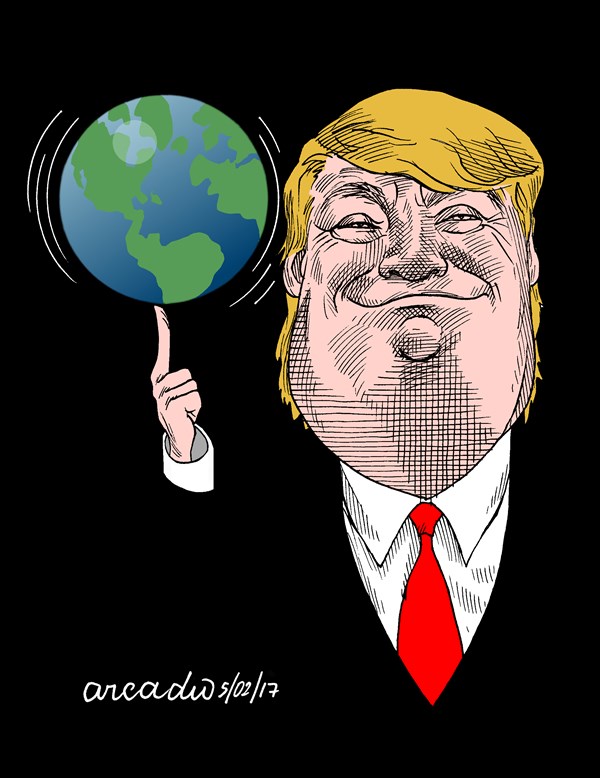
Every president needs to publish a national security strategy during their term. Trump did so in his first term, and that document stressed great power competition at every opportunity. President Joe Biden committed his own strategy to paper, citing China as an aspiring global hegemon that the United States needed to cooperate with when possible and contain when needed. Trump's second-term strategy, just published, goes beyond that relatively uncontroversial theme by stressing U.S. sovereignty and power above all other considerations.
There are some items in Trump's national security strategy that are positive and frankly refreshing. It ditches the rules-based order pablum we often hear from U.S. politicians ad nauseam, a construct that elevates universal values and suggests that international politics are governed by a set of hard-and-fast laws, rules and conventions. But the world doesn't work like that; power and interests, not the United Nations charter, govern how states behave. And the United States, a country that wrote the rules after World War II, isn't exactly shy about abandoning those rules when it suits our agenda. If you don't believe me, just look at the 2003 war in Iraq, which wasn't authorized by the U.N. Security Council, or Washington's support for some nasty autocrats who are deemed strategically important (rightly or wrongly). At least we're no longer pretending a rules-based order exists.
Moreover, Trump's overall goals in the strategy are quite conventional. In the Western Hemisphere, the Trump administration seeks to make the lives of cartels, drug traffickers and human smugglers miserable; preserve its superior position in the region relative to other non-hemispheric powers such as China and Russia; and ensure strategic locations such as the Panama Canal are secure. In Europe, U.S. officials are pressing the issue of burden sharing and incentivizing Washington's European allies to take more responsibility for their own security. In East Asia, the United States hopes to maintain a stable balance of power with China, whose own military capability is exceedingly more impressive than it was a decade earlier. And in the Middle East, striking peace agreements is the primary objective. It's hard to see why anyone would have an issue with any of this.
Yet to describe the White House strategy document as all roses would be a gross oversimplification as well. The White House and the president himself preach the value of noninterventionism in other states' domestic politics, but this is hard to square with Trump's incessant meddling in foreign elections. Before Argentines went to the polls in October, Trump endorsed Argentine President Javier Milei's party and threatened to revoke a $20 billion bailout package if the results weren't to his liking (they were). In November, days before Hondurans were set to vote for a new president, Trump waded in and endorsed Nasry “Tito” Asfura, a right-wing politician. And again, Trump used his favorite tool: coercion. “If Tito Asfura wins for President of Honduras … we will be very supportive,” Trump wrote Nov. 28. “If he doesn't win, the United States will not be throwing good money after bad, because a wrong Leader can only bring catastrophic results to a country, no matter which country it is.” The votes in this tight race are still being counted.
Trump's policy in Latin America is also working at cross purposes with his lofty objectives. As the national security strategy stresses, the United States aims to get more Latin American countries to buy into the U.S. sphere of influence. That's all well and good.
But U.S. activities in the hemisphere are complicating precisely what the Trump administration wants to achieve. Trump's decision over the summer to institute arbitrary tariffs on Brazil, Latin America's largest economy, in an attempt to coerce Brazilian President Luiz Inácio Lula da Silva into dropping the prosecution of his political adversary, Jair Bolsonaro, has been incredibly counterproductive. First, the economic pressure failed to push the Brazilian government into dropping Bolsonaro's case. Second, with the U.S. market more expensive, the tariffs accelerated trade activity between Brazil and China, which while not a bad thing in its own right is still indicative of the Trump administration's often-unsophisticated, ham-fisted approach. And third, the U.S. economic penalties have provided Brazilian foreign policy officials with even more reason to pursue a multivector foreign policy that doesn't fully align with Washington.
The ongoing U.S. strikes on boats in the Caribbean and Pacific Ocean aren't doing the U.S. any favors either. Sure, there are some countries in the region, such as Trinidad and Tobago as well as the Dominican Republic, that are supportive of the Trump administration's militarized war on drugs. But the vast majority are firmly opposed due to the moral aspects involved as well as the actions' ineffectiveness on a more practical level. Colombian President Gustavo Petro has feuded with Trump over what he calls state-sanctioned murder, and Colombian intelligence officials have reportedly limited counternarcotics cooperation with Washington in response. Brazil is aghast at the tactics. And Mexico, one of the most important U.S. counternarcotics partners in the world, has no intention of lending a hand in these strikes.
The good news: Trump's second national security document could have been much, much worse. It also could have been better.
Whether it matters at all will be determined by Trump's capacity to see it through.
Previously:• 01/23/25 Let's not overreact to Gaza ceasefire
• 01/21/25 Are Trump's peace dreams for Ukraine mission impossible?
• 12/31/24 How will Syria evolve under new leadership?
• 11/14/24 How will Trump handle the war in Ukraine?
• 11/04/24 Is there really an 'axis of evil' set on destroying the US?
• 11/30/23 What will happen after the Israel-Hamas truce expires?
• 11/09/23 Pessimism is growing in Ukraine. Has the war with Russia reached a stalemate?
• 10/26/23 Biden's geopolitical equivalent of a high-wire act --- and success is by no means assured
• 10/12/23 How will the Israel-Hamas conflict affect US policy?
• 10/05/23 As the war in Ukraine grinds on, Europe will prove more crucial
• 09/18/23 The US and Vietnam should boost their relationship. China looms large
• 08/24/23 Zelensky's shiny, new toys and yet --- racking-up losses
• 08/17/23 The US is negotiating with Iran to release prisoners. Here's why that matters
• 08/03/23 What should the US do to normalize ties between Israel and Saudi Arabia?
• 06/09/23 Do we face nuclear confrontation? The erosion of agreements has heightened the risk
• 06/01/23 Why is the Defense Department immune from budget cuts?
• 05/18/23 Policy is at a crossroads in a deeply troubled Afghanistan
• 05/12/23 The US war on terror continues. We just don't talk about it
• 05/05/23 The US and world were naive about Sudan leaders' commitment to democracy
• 03/20/23 China gets the credit for improving Iran-Saudi Arabia ties --- but the US benefits
• 02/23/23 The first year of war in Ukraine has defied predictions
• 02/07/23 How does the US-China relationship continue after the spy balloon saga?
• 12/29/22 Why does the US defense budget continue to grow? America's approach needs rethinking
• 12/22/22 Ever so slowly, the nations are realigning
• 12/22/22 China is pushing a pacifist Japan into building up its military capabilities
• 12/09/22 Mideast country is putting US in a tough spot by threatening another Syria incursion
• 10/13/22 Don't underestimate the durability of autocracies
• 09/22/22 Is there still hope for a new Iran nuclear deal?
(COMMENT, BELOW)
Daniel DePetris
Chicago Tribune/(TNS)
Daniel R. DePetris is a fellow at Defense Priorities, a foreign policy think tank based in Washington, D.C., and a syndicated foreign affairs columnist for the Chicago Tribune.