




 Contact The Editor
 Articles By This Author
Two political leaders have exchanged barbs underlining the powerful nuclear arsenals of their respective nations. It was not just a pointless demonstration of bravado - it also showed that careless words and vague military threats can move the world closer to a disastrous conflict.
The first to lash out was Dimitry Medvedev, a former president and prime minister of Russia, who now serves as deputy chair of President Vladimir Putin's security council. In a social media post, he said a US ultimatum for Moscow to come to the negotiating table over Ukraine was a "threat and a step towards war." Later, he alluded to Russia's "dead hand" nuclear launch system, which automatically fires a nuclear strike if the nation is attacked with such weapons.
President Donald Trump responded to Medvedev's comments by saying he had ordered two nuclear submarines "to be positioned in the appropriate regions." He concluded by saying, correctly, that "words are very important and can often lead to unintended consequences, I hope this will not be one of those instances." (Later, a Kremlin spokesman warned against "nuclear rhetoric.")
Between them, the US and Russia have more than 10,000 nuclear weapons. How dangerous is this war of words between the Kremlin and the White House? And what is the significance of Trump claiming to have moved nuclear submarines to new stations?
I'm not a submariner - or a "bubblehead," as they are known (more-or-less affectionately) in the Navy. But I've commanded them in combat as a commodore and a rear admiral, directed the launch of their conventional Tomahawk missiles at terrorist targets in Africa and Asia, and sailed in them from time to time. I like to say these formidable warships are the apex predators of the ocean. And their locations are always kept secret.
As an anti-submarine-warfare officer for three years on a destroyer early in my career, I hunted both Soviet and Chinese subs and, in exercises, American boats. ("Boats" is the colloquial term for submarines, whereas surface combatants are "ships.") We like to think of our destroyers as the greyhounds of the sea, and lethal to submarines; but truth be told, more often than not we ended up the target rather than the hunter in those drills against US boats.
The US operates three types of nuclear-powered submarines, each posing a different level of threat to Russia. It is unclear which of the three types Trump claimed to have moved around; all US nuclear subs are capable of clandestine operations throughout the world's oceans.
First, and by far the deadliest, are huge ballistic-missile boats: Ohio class SSBNs, which displace 20,000 tons when fully submerged. The Navy has 14 of these killer whales, each capable of carrying 24 Trident II nuclear-tipped missiles with ranges exceeding 4,000 miles. The missiles are in vertical tubes at the center of the boat, and the crew of 150 officers and enlisted men and women call that part of the warship "Sherwood Forest" - a stand of lethal tree trunks. While more than half the Ohio class are usually on patrol, it seems unlikely that Trump would have ordered changes to their movements given the extraordinary range of their missiles.
The second big group of nuclear-powered submarines is the attack boats, or SSNs. The US currently operates three classes - Los Angeles, Seawolf and Virginia - totaling just over 50 warships. These are multi-mission platforms: they can hunt enemy submarines; launch long-range Tomahawk missiles at land targets with pinpoint accuracy; gather intelligence covertly; and sink enemy military and civilian surface ships. The three classes vary in size from 7,000 to 9,000 tons and their weapons and sensors vary - but all are deadly and very difficult to find through acoustic surveillance. I was glad to have two of them loosely assigned to my strike group in the early 2000s.
Finally, four Ohio-class behemoths have been converted to carry more than 150 Tomahawk land-attack missiles in the tubes that formerly held ballistic missiles. These are favored by combatant commanders because of the big load of missiles, which constitute a strike group's main battery. Since the Tomahawk's range is about 1,500 miles, these would probably be the boats Trump moved, presumably closer to Russia. He may have designated the commander of US European Command, my old position, as the operational commander. These missiles could hold at risk Russian command-and-control nodes, supply routes and military targets.
That said, I've met Medvedev, and he is not a serious player in Putin's universe despite his political resume. Trump should ignore his erratic commentary and focus on putting pressure directly on the Russian economy.
For that, the best weapons are not "haze grey and underway," as we say of the subs. They are economic tools, especially secondary sanctions applied to Russian oil customers, and confiscation of Russian funds frozen in Western banks. As tempting as it is to move nuclear submarines around, the means to bring Putin to the table aren't America's killers of the deep.
(COMMENT, BELOW)
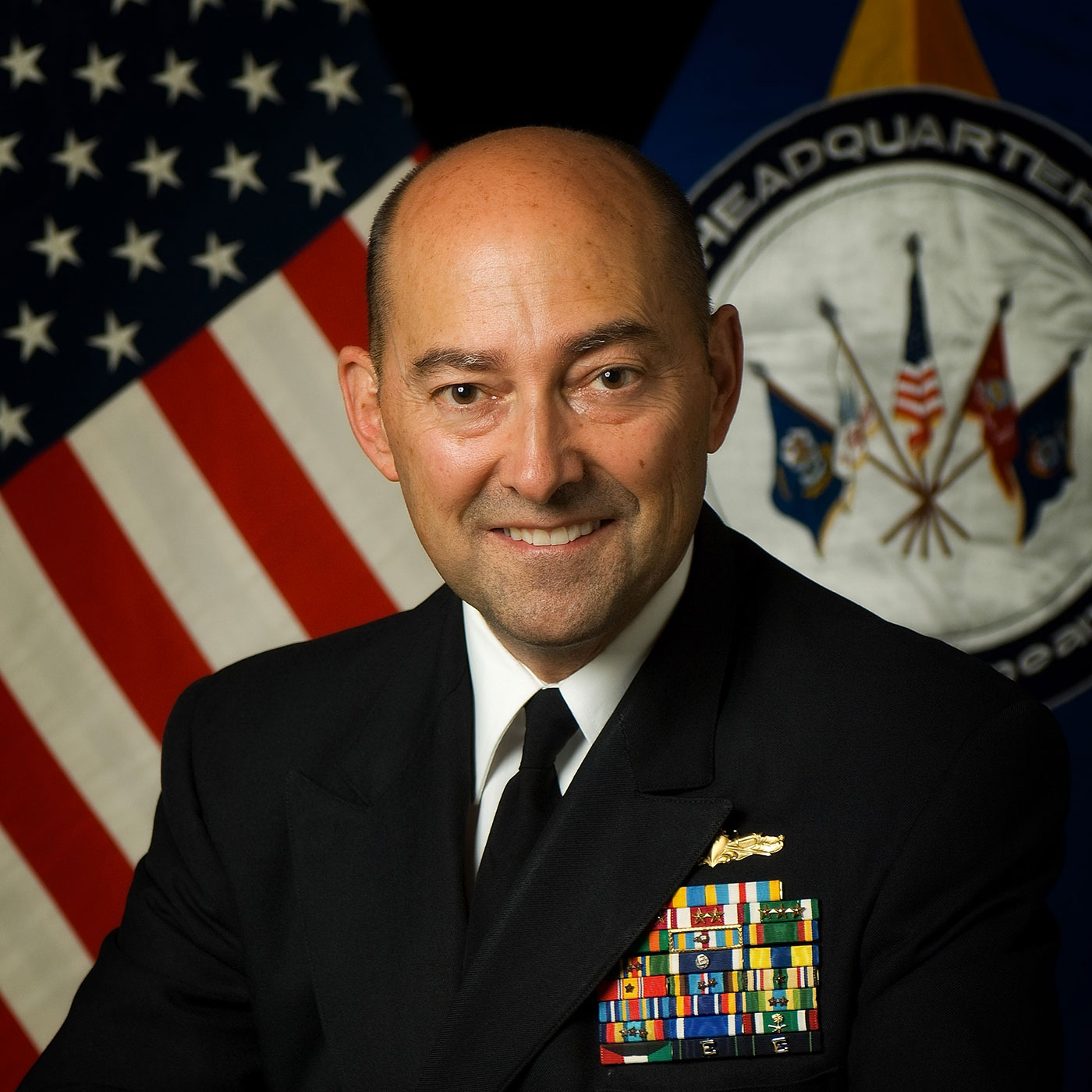
Stavridis is a Bloomberg columnist. He is a retired U.S. Navy admiral and former supreme allied commander of NATO, and dean emeritus of the Fletcher School of Law and Diplomacy at Tufts University. He is also an operating executive consultant at the Carlyle Group and chairs the board of counselors at McLarty Associates.
Previously:
• 02/10/26 If the US leaves NATO, Europe can protect itself
• 01/27/26 While Washington debates Greenland, Iran is bleeding
• 10/16/25 Putin is taking his hybrid warfare to the sea
• 03/18/25 Ukraine needs US weapons but it needs intelligence more
• 02/14/25 Trump's 'Iron Dome' must succeed where Reagan's 'Star Wars' failed
• 09/13/24 Ignore Hamas' trendsetting warfare and risk the West
• 06/26/24 Here's how to stop the Houthi attacks at sea
• 05/15/24 Putin's next target may be the 'NATO lake'
• 04/09/24 Latest ISIS attacks show the war on jihad is heating up
• 02/21/24 Ukraine's military reset is doomed without more US aid
• 12/21/23 US-led Naval force might not end Houthi ship attacks
• 11/22/23 Send America's floating hospitals to Gaza
• 11/08/23 What the US should do about Iran
• 08/30/23 Haiti needs a new UN mission, this time led by the US
• 08/16/23 To stop Iran's threat to Gulf ships, send the Marines
• 07/28/23 NATO convoys can protect Ukraine's grain harvest from Putin
• 07/28/23 Sweden and Finland give NATO an Arctic opportunity
• 07/11/23 US military's recruiting woes are a national-security crisis
• 06/02/23 Ukraine war may become a proving ground for AI
• 05/16/23 Iran's tanker seizures may bring U.S. convoys back to the Gulf
• 05/08/23 Sudan rescue mission is helping the US Navy prepare for war
• 05/01/23 Ukraine is running out of ammo. So is the US
• 03/10/23 The US military must create a Cyber Force
• 12/07/23 Putin will carpet-bomb Ukraine unless the West acts
• 10/14/22 Putin's campaign of terror from the air is already failing
• 09/08/22 Iran reveals how its naval warfare is changing
• 08/02/22 US needs a global alliance against Russia's cyberattacks
• 06/28/22What to expect from NATO's new strategic concept
• 04/13/22 Nukes? Ukraine war's most potent weapon may be a cell phone
• 01/18/22 Russia is pushing Finland and Sweden toward NATO
• 10/20/21 What Colin Powell taught me about war and optimism
• 09/14/21 Why the U.S. Navy is hunting pirates off Africa
• 07/29/21 Cuba and how Biden can avoid another Mariel boatlift
• 07/01/21 Donald Rumsfeld never gave in
• 02/16/21 Keeping troops in Afghanistan makes America safer
• 08/19/20 Military reasons to celebrate the Israel-UAE deal
• 07/02/20 Taliban bounties would be a new low even for Putin
• 01/02/20 May the 'Space Force' be with you
• 08/02/19 What Iran will do next, and how to stop it
• 05/06/19 The 'Five Eyes' intelligence-sharing alliance should expand, starting with Israel and Japan
• 04/24/19 Sri Lanka attacks mark the birth of terrorism 3.0
• 01/14/19 Iran's tiny navy is trying to revive the Persian Empire
• 06/04/18 US was right to give China's navy the boot
• 06/04/18 Big winner of Colombia's election is the US
• 05/17/18 Great power politics is back as U.S. aims at Russia with resurrected Navy fleet
• 03/20/18 Fake advice for Putin's fake win