
MUGGER


http://www.jewishworldreview.com --
TAKING NOTE of the continuing, and shameless, nonstop media coverage of
the Kennedy-Bessette tragedy is unavoidable if you’re a sentient being,
especially in New York City.
A number of disparate observations struck me during the last week, sedated though I was by the crass commercialism on eBay, the JFK Jr. shills-for-hire on tv (historian Douglas Brinkley, brilliantly dubbed “the William Ginsburg of the Kennedy death circus” by Slate’s David Plotz, is only the most obvious example, perhaps followed by George contributor Al D’Amato) and endless loops of Jack and Bobby Kennedy’s funerals and Uncle Ted’s eulogies. It’s not as if this footage is unfamiliar: every time there’s an anniversary of a Kennedy death (but not of the deaths of Bobby’s sons David and Michael), the same scenes are broadcast on almost every television station. And if I hear or read one more time the comment from Ed Koch that he’d sent Kennedy a note after the latter failed his bar exam, telling him it was no big deal, after all he flunked the exam too and became mayor, I’ll don a Rudy Giuliani mask and tap Koch on the shoulder at his favorite Village restaurant.
I have no idea why so many newspaper columnists had to write five or more pieces on the catastrophe: it’s not as if they added a single new insight. Locally, I found Newsday’s Ellis Henican over the top when he declared last Sunday that the media deserved praise for its intrusive coverage: “I am not at all ashamed of my business this week.”
Henican’s co-perpetrator, Jimmy Breslin, perhaps with the help of Jesse Jackson, upped the ante on the same day: “On North Moore Street, hour after hour, for days and nights, there were these silent throngs appearing out of the hot sun and darkness, people of so many colors and oblivious of it, that they put a thrill, and so much hope into the night. There has no been no sight like it since 1968.” What “thrill” and “hope” of ’68 was Breslin daydreaming about? The assassinations? Vietnam? Chicago’s Democratic Convention? The riots in several major cities? The Tet offensive?
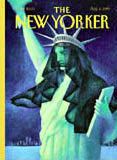
As for all the “hope” at the carnival on N. Moore St., it’s actually fairly revolting. We have a new tourist destination in Tribeca; aside from the ever-present tv crews there are double-decker buses parking on the corner and people slurping ice cream cones while they wait on line to get a gawk at the shrine. One visitor, a Russian who now lives in Texas, asked a local, “Which way is N. Moore St.? And where is 5th Ave.? Also, is Washington, DC nearby?” As Michael Wolff writes in the Aug. 2 New York, “[I]f you had gone down and hung around the TriBeCa stoop when they were alive, you’d have been arrested as a stalker.” (Wolff’s piece “Kennedy With Tears” was better than most, but ended with his signature twist that leaves you wondering “Say what?” His last two paragraphs: “The Kennedy-family business isn’t politics; it’s death, and the fantasies that death allows. We are ennobled by the grief we share with the Kennedys, and by the better, more interesting lives we’ve all lost without their sons.
“Apparently, we need this.”
 |
The Post’s Andrea Peyser, inadvertently injecting some levity into her sloppy, sentimental writing, came up with this whopper on July 24. “His spirit belonged in the wind. Yet the official memorial took place uptown, in the pricey reaches of the East Side that John Kennedy long ago abandoned for downtown funk.” I haven’t heard the word “funk,” unless ironically, in years; but what kind of fool is Peyser to describe Tribeca, the most affluent part of town other than the Upper East Side, as funky? I applaud the Post’s practice of employing a lean editorial staff—The New York Times in particular would benefit if it trimmed its workforce by half—but certainly there’s an editor who realizes that Peyser, while she shouldn’t be drummed out of the business, really belongs at a magazine like Tiger Beat.
But it was the Post’s Steve Dunleavy who took top honors for whoring a celebrity story. On July 23, he wrote: “Life goes on, yet you wonder why the Kennedys have been handed so much premature death. It doesn’t seem fair. And it isn’t.” And the next day: “Well John-John we did know you because you let us know you and that makes you a real New Yorker. We kidnapped you and thank God you went along for the ride.” Right, so Dunleavy could milk two weeks of easy gibberish passed off as prose and collect a paycheck.
But examine Dunleavy’s slipshod collection of columns (and I say that even though I agree with many of his political opinions: it’s just that he’s a bad writer) from the past 12 months and you’ll find a different view of the Kennedys. For example, on July 27, 1998, in a piece about Bill Clinton’s subpoena to appear before Ken Starr, he wrote: “The master of the media game was a wise old owl called Joe Kennedy who knew edition times of newspapers as well as most editors. He would tell his sons, and believe me they took notice of him: ‘Break bad news on a Friday, because the edition times are earlier and the newspapers are smaller.’ I have seen the Kennedys, for the last 30 years’ worth of scandals, do exactly that. I even co-authored a book with my colleague Peter Brennan about just how the wild, wild Kennedy boys played all of us reporters like violins.”
And then on November 24, 1998, in an article about District Attorney Robert Morgenthau: “With the exception of Morgenthau’s habit of hiring members of the Kennedy family who are academically challenged, he has proven to be a steady and decent prosecutor.”
 |
| Barnicle |
In his Sunday column, Barnicle, still bitter about his justified firing from the Globe last year, blaming “small publications” for the dismissal rather than his blatant plagiarism, wrote that Kennedy was a gentleman about the ’97 column, and “proved to be far more forgiving than I would have been under similar circumstances.”
At the other extreme, The New Republic commissioned the tiresome Neal Gabler for a highbrow article, imaginatively headlined “The People’s Prince,” for its Aug. 9 issue. After reading the following tripe, maybe you’ll think it’s best to stick to the tabs: “For JFK Jr., the extremes were indeed extreme—the promise of his life and the tragedy of his death. Unlike most celebrities, he was born of gods—the son of an improbable marriage between the Apollo and Aphrodite of American politics and the grandson of the Zeus and Hera of twentieth-century America, Joseph and Rose Kennedy. Hubris, the bane of the classical hero and the occupational hazard of the modern celebrity, was in his blood, though in the case of the Kennedys the sense of ease and entitlement, the feeling that there were absolutely no limits to their dreams, presented itself less often as overbearing arrogance than as confident charm.”
Yes, Neal, Teddy Kennedy’s blaming a family curse for his reckless actions at Chappaquiddick 30 years ago was indeed charming. Here’s something I don’t quite understand. It’s agreed that JFK Jr. was dealt a royal flush in life’s lottery; that he chose not to play that hand especially well is not for others to judge, but it does make you wonder. For all the talk about the Kennedy family’s intense loyalty—which for the most part is on the mark—the slain President’s son doesn’t fall into that category. How else to explain his obscene cozying up to Larry Flynt just a few months ago at the White House Correspondent’s Dinner in Washington, DC?
He embraced a man who, years ago, published nude photos of his mother, the woman who’s rightfully praised as a shrewd lioness who consciously attempted to keep her two children out of the media’s glare, and frowned upon their consorting with the wilder Kennedy cousins. If it was your mother whom Flynt had exploited in his trashy Hustler, would you suck up to him years later? Similarly, as I wrote a month or so ago, I don’t understand why Kennedy accepted ads from the NRA in his magazine George. It wouldn’t make business sense to turn down the cash, especially for a floundering publication on the verge of extinction, but you’d think that a man whose father was murdered by a gun-wielding assassin would have such a visceral emotional reaction against the NRA that he’d refuse the ads. It just shows me that young Kennedy was a little bit off.
 |
| Flynt |
On Chris Matthews’ Hardball last week I saw Mort Zuckerman and Jerry Nachman, expressing their sorrow and respect for Kennedy, and they related stories of how he’d gently chide them for their respective tabloids’ relentless coverage of every move he made. But if he was really troubled by the paparazzi, why would he play Frisbee in Central Park without a shirt on? Obviously, he liked to show off his fine physique and enjoyed the attention. Also strange was the near-nude photo he published of himself in George that accompanied his editor’s letter chastising his cousins as “poster boys for bad behavior.” That sort of decision simply doesn’t square with the Kennedy family’s reputation for unswerving Irish loyalty.
Perhaps the most galling sentiment heard on television shows was that JFK’s assassination was the key event in American history this century. That’s perhaps true for a portion of the populace, the Boomer generation specifically. I don’t exclude myself from this group. I remember exactly where I was when the President was shot—on a school bus coming home when the normally jolly bus driver Paul told the mass of third-and-fourth graders to shut up and pray for Mr. Kennedy. And when I got home from Sunday school two days later, I witnessed, along with my mother, the live killing of Lee Harvey Oswald. To an eight-year-old boy, it was both thrilling and frightening.
 |
| Broder |
The Daily News’ Jim Dwyer is an admirable city columnist; I don’t often agree with his politics, but his prose is steady and well-reported. But even he fell prey to the Camelot dust that was scattered about the land in the past week. Writing on July 22, he made what I consider a preposterous statement: “[JFK Jr.] was the only infant to live in the White House this century; his father was the most famous murder victim in United States history; at a moment when many Americans first owned television, he was the first little kid they saw on the screen. And he was impossible to forget.”
Dwyer’s not a stupid man, and surely if he reread his piece he’d realize how filled with holes it was. Obviously, Abraham Lincoln, who presided over a civil war, ended slavery, and delivered a short speech, the Gettysburg Address, which was more powerful than anything Ted Sorensen wrote for John F. Kennedy, was “the most famous murder victim in United States history.” And revisionists can’t have it both ways: it’s largely acknowledged that Kennedy won the 1960 election because of the televised debates. In fact, it could be argued that Little Ricky on the sitcom I Love Lucy was the first kid that a majority of Americans saw on tv. And though John Jr.’s heartbreaking salute to his father at the funeral in ’63—it makes little difference that Jackie Kennedy rehearsed him for the moment—was poignant, in the aftermath of the assassination it was possible to “forget” the three-year-old, and most Americans did as they went about their daily lives. It was only later, when John Jr. was an adult and became a celebrity in his own right, that he regained the spotlight he’d held so briefly in the early 60s.
 |
| Schmoke |
But affirmative action has always existed; it’s just taken different forms, like the Old Boy Network, the clubbiness that allows children of privilege, like the Kennedys, into schools they’d be rejected from had they been born with different names. Likewise, it’s rampant in the media and in politics. Yet for the life of me, I can’t figure out why a lightweight like Albert R. Hunt is allowed to continue at The Wall Street Journal. Probably more than any other Beltway media insider, Hunt can be counted upon to champion the Democrats’ agenda, and with a far more strident tone than his peers. His July 22 column on John Kennedy Jr., entitled “America’s Family,” was filled with the symbolism and the nostalgia for a long-ago era that make Hunt a fixture at DC cocktail parties, but did little to edify his readers. Most WSJ subscribers I know just skip his column; I imagine most of the paper’s staff does as well.
 |
| Shriver |
Hunt wouldn’t include this particular anecdote about President Kennedy, public champion of civil rights, but Peter Collier, in the Aug. 9 National Review, did: “In one famous moment, when his brother was brooding in the Oval Office, Jack told a friend who noticed it, ‘Oh, don’t worry about Bobby: He’s probably all choked up over Martin Luther King and the Negroes today.’”
On the other end of the spectrum, the churlish John Podhoretz wrote a scathing attack on patriarch Joseph Kennedy that ran in the early editions of last Wednesday’s Post, before being yanked by editor Ken Chandler. It was inappropriate, certainly at that date, and was a not particularly clever take on an imaginary Faustian deal Papa Joe Kennedy made with the devil, which resulted in all the family’s future fortune and tragedy. The telling paragraph, however, goes to Podhoretz’s anger at what he perceives as the family’s anti-Semitism. That anger probably motivated the column. He writes, in the voice of Satan: “I can’t tell you how it filled me with pride just to know you back when you were America’s ambassador to England, saying all those nice things about Hitler, doing everything you could to prevent Jewish emigration from Nazi Germany. Thousands of Jews died because of you. That was quite a demonic performance!” Podhoretz takes a swipe at Teddy Kennedy, too:
 |
| Kopechne |
Then there’s President Clinton, the First Emoter. I suppose he could’ve been more unctuous during the past week’s events—he was almost restrained—yet he couldn’t resist lying about being the first president to have John and Caroline Kennedy back to the White House for a visit. As many pointed out seconds after he made that smiling, warm statement, the Kennedy children were feted by Presidents Nixon and Reagan.
When Clinton weighs in on moral and spiritual matters such as the Kennedy/Bessette plane crash (or Littleton, Oklahoma City or Kosovo), it’s not just instantly hollow and horrendously insulting. It’s also tiresomely apparent that this man has forfeited his right to be the country’s healer/griever. He isn’t qualified. This man is an exposed liar, chronically insincere, a congenital phony. Is there anyone who isn’t aware of the lip-biting, method-acting technique? Is there anyone who doubts Clinton’s inner glee at the First Healer star turn an opportunity such as this presents? I wish there was a congressman who had the balls to make a speech in the House of Representatives proposing legislation that prevented impeached, disgraced presidents from expressing sorrow on behalf of the American people.
In Saturday’s Boston Globe, John Ellis went against the grain of his fellow pundits, especially in that region, and wrote about the tv ratings race—not to mention the extra millions made by magazines with commemorative issues, the dirty secret that someone like Hunt would never admit. He was particularly on target with this passage: “Last Saturday morning, Barbara Walters abandoned the Hamptons and came clucking back to ABC headquarters in New York, talking on her cell phone down the Long Island Expressway about her ‘personal friendship’ with John F. Kennedy and what his death meant to the country.’
“There was a time, during President Kennedy’s era, when Barbara Walters was just the host of a morning chat show. No one cared what she thought. No one would have thought to ask. But over the years, through some terrible, Hogarthian transformation, she has somehow become Babwa Wawa, the insufferably overbearing mother hen, smothering us with her claustrophobic self-importance and faux concern.”
 |
| Walters |
“I don’t think people today are any more ‘addicted’ to this sort of
thing than they were in years and centuries past. But how news of a
famous person’s death reaches us keeps changing. Booth shot Lincoln and
word spread faster than in previous generations because of the
telegraph. Newspapers printed special editions. Ford’s Theater became,
and still is, a tourist attraction. JFK was assassinated and a lot of
people watched tv for three days. The book depository in Dallas is now a
strange museum. JFK Jr. goes down in a plane and you inform me by e-mail
before I see the morning paper or turn on the television. Some people
spent the week looking at old pictures of John-John on CNN. This is
obsessive behavior, but then it always has

JWR contributor "Mugger" -- aka Russ Smith -- is the editor-in-chief and publisher of New York Press. Send your comments to him by clicking here.


07/28/99: Trailing the Bad Guys
07/23/99: Stop the Whining!
07/21/99: What the World Needs Now?
A News Blackout
07/16/99: Time of the Season
07/14/99: Hillary Sucks Up The Media’s Gush And Mush
07/09/99: Hillary & Sharpton: So Happy Together
07/07/99:
Al Gore’s Mondale Impersonation;
Bush Conquers California
07/02/99:Make Room for MUGGER
06/30/99:It’s Not Too Early: Gore Needs to Raise the Bar
06/25/99: Summertime Cruise
06/23/99: The Times Unofficially Endorses Gore: Bush Confuses The Media
06/18/99: Taki Growls And Prowls
06/16/99: Bush Begins His March: The Beltway Pundits Pout
06/11/99: In the Days Of Gold
06/09/99: Pollution Alert: Hillary Clinton Loves New York
06/03/99: Life in the Danny Thomas Suite
06/02/99: A McCain For All Seasons
05/28/99: Brill's in The Wrong Profession
05/26/99: Gun Control Solves Everything
05/20/99: Gross, Quasi-Gifted and Broke (For Now)
05/19/99: Gore Pushes The Panic Button—Again
05/14/99: Watch Out: There's Someone's Behind You
05/12/99: Memory? What's That You Asked?
05/07/99: There Will Always Be a Washington, DC
05/05/99: Colorado Exploitation:
Why Can't CNN Just Go Home?
04/30/99: John John: I'll Moonlight, Too
04/28/99: T.J. Walker's The Man!: A Former Clinton Disciple Repents
04/23/99: Baseball and Politics
04/21/99: Sharpton's Nostalgia Trip Is a Bust: The Backlash Is Immediate
04/16/99: Notes From A Baltimore Hick:
Pressing My Nose Against the Window
04/14/99: The Bush JugGoreNaut Continues; Send Sharpton to A Rwanda Fat Farm
04/09/99: John McCain's Moment
04/07/99:The Media Flips: It's No Longer "Just About Sex"
04/05/99: The Gore Republic Gets Dressed Up. So What?
03/29/99:Louder Than Bombs: Jetlag and English Manners
03/26/99: Hollywood's Horror Show
03/24/99: Black Ops Mark Vietnam War, Class War & the POW/MIA Issue
03/19/99: The Wealthy Survivor
03/17/99: Clinton's a Broken Man: The GOP's Huge Opportunity
03/12/99: Like Father, Like Son: New Hampshire in Another Era
03/11/99: Who is Dorothy Rabinowitz?
03/10/99: It's George W.'s to Lose
02/26/99: Springsteen Ain't No Chopped Liver; Vanity Press Musings
03/05/99:
This Must Be the New World:
The Mainstream Is Left Behind
02/26/99: Hillary, Juanita & Rudy Kazootie; First Baker, then Rich and Soon Lewis
02/24/99: The New Yorker Takes the Local:
Mister Hertzberg Strikes Out; A Search for the Clemens Upside
02/19/99: The Howell Raines Conspiracy
02/17/99: History Lessons: An Immigrant's Advice
02/12/99:The Man Who Owns the World
02/10/99:The Impeachment Trial Splatters: Lindsey Graham Emerges a Hero
02/05/99: A Slight Stumble for Bush
01/29/99: Rich Is Back in the Tank
01/29/99: Not So Fast, Mr. & Mrs. Pundit
01/27/99:This Is Not America:
Clinton's Set to Walk and Party On, Suckers
01/25/99:Sniffles and High Fever: Kids Say the Darndest Things
01/20/99: Whole Lott(a) Waffling Goin' On
01/14/99: Senator Hillary Rodham in 2000:
The First Step Back to the Oval Office
01/08/99: Drudge Is the Hero
01/06/99 : MUGGER & the Martians
12/30/98 : Last Licks of '98:
Some Heroes, Several Villains & Many Idiots
12/17/98 : Boy Mugger's obsession
12/11/98: Irving's the King Wolf
12/09/98: What do Matt Drudge and Tom Hanks have in common?
11/26/98: Starr's Magnificent Moment
11/18/98: Who could have imagined!?
11/11/98: Send Dowd Down to the Minors
11/05/98:
Feeding Gore to
a shark named Bush
10/30/98: "Pope" Jann and his rappers speak ---it's time for fun again
10/28/98: Lowered expectations, but the GOP holds the cards
10/23/98: Speaking from Zabar's: Michael Moore!
10/21/98: Bubba redux?
His uptick won't last
10/16/98: Gore for President: The Bread Lines Are Starting to Form