




 Contact The Editor
 Articles By This Author
What is driving the Iranian desire to capture these high-tech vessels? And, alongside the successes of drones supplied to Ukraine by the U.S. and its allies, what does it tell us about the future of warfare?
Going back two decades to my time as a strike group commander centered on the aircraft carrier Enterprise, I've been a strong advocate for this type of innovation. We were given several experimental vessels developed by the Defense Advanced Research Projects Agency during the wars in Iraq and Afghanistan, and used them for surveillance of the northern Gulf to stop shipments of weapons, drugs and terrorists.
A few years later, as head of U.S. Southern Command, I requested and received unmanned maritime vehicles for use against drug runners in the Caribbean and along the Pacific coasts of Central and South America.
Drone technology has of course advanced remarkably since then. Unmanned naval platforms now carry a variety of sensors, including cameras (for identification of targets), radar (to track surface shipping such as the ubiquitous dhows of the Gulf) and sonar (to listen underwater for high-speed smuggling vessels).
One big advantage is that lacking a crew, these sea drones don't need to come to port for rest and recuperation, and there are no embarked personnel who could be injured or killed by an opponent. The 23-foot Saildrone Explorers briefly taken by Iran are solar- and wind-powered and thus don't need refueling. (Disclosure: I have been an adviser to Saildrone.)
The Navy has created Task Force 59 to bring unmanned capability to the Navy's Fifth Fleet, which oversees the Gulf and the waters of the Red and northern Arabian Seas. It is led by Commodore Michael Brasseur, an extraordinary innovator who was part of my team at the Navy's think tank, Deep Blue, after the Sept. 11 attack on the Pentagon.
Brasseur has introduced the latest generation of unmanned maritime- and air-surveillance vessels into a very complex tactical and geopolitical situation. The Iranian seizure, while unfortunate, demonstrates how much he and his team have achieved in a short period of time. In both incidents, the responses by (crewed) U.S. Navy warships were almost immediate, and the sea drones were recovered within hours. Brasseur told me that the vessels were illegally taken in international waters, and they were conducting unclassified operations.
The lessons we should take away from operating such drones in contested waters and airspace of the Gulf and Ukraine are clear.
First, increased use of surveillance, targeting and strike operations from unmanned systems will put pressure on large, traditional systems, which are very costly in terms of construction and workforce. Successes in the Ukraine war, both ashore and at sea (drones were probably central to the sinking of Russia's Black Sea flagship in April), will accelerate the trend.
Second, America's rivals are going to want to capture its drones, not simply destroy them, in hopes of reverse-engineering the technology. The U.S. military will have to thwart or react quickly to such captures. Still, some will fall into enemy hands: Placing strong defensive systems on these platforms isn't currently feasible at a cost that makes sense. An alternative would be self-destructive capability - either explosive or software-based - that can be activated when a signal connection is lost.
Third, the Pentagon needs to recognize the importance of overarching connectivity. The linkages between sea drones, overhead unmanned vehicles, space systems in low-earth orbit, and teams of special forces such as Navy SEALs are crucial.
Finally, the Pentagon should look at collaboration opportunities. Many tech and manufacturing companies would be willing to provide test beds for the Navy and the other services. Bringing in the Air Force and the nascent U.S. Space Force to work on resolving the challenging multi-domain issues of modern combat is crucial.
The Fifth Fleet recognizes that the Iranians will continue to try to capture experimental drones. It must be given resources and aggressive rules of engagement needed to protect these valuable unmanned systems while they push the envelope of experimentation. Drone piracy is here to stay.
(COMMENT, BELOW)
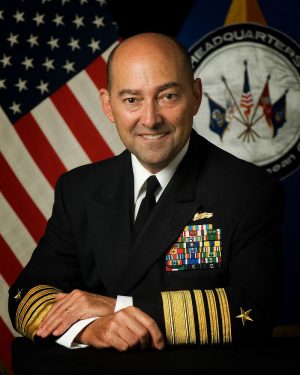
Stavridis is a Bloomberg columnist. He is a retired U.S. Navy admiral and former supreme allied commander of NATO, and dean emeritus of the Fletcher School of Law and Diplomacy at Tufts University. He is also an operating executive consultant at the Carlyle Group and chairs the board of counselors at McLarty Associates.
Previously:
• 08/02/22 US needs a global alliance against Russia's cyberattacks
• 06/28/22What to expect from NATO's new strategic concept
• 04/13/22 Nukes? Ukraine war's most potent weapon may be a cell phone
• 01/18/22 Russia is pushing Finland and Sweden toward NATO
• 10/20/21 What Colin Powell taught me about war and optimism
• 09/14/21 Why the U.S. Navy is hunting pirates off Africa
• 07/29/21 Cuba and how Biden can avoid another Mariel boatlift
• 07/01/21 Donald Rumsfeld never gave in
• 02/16/21 Keeping troops in Afghanistan makes America safer
• 08/19/20 Military reasons to celebrate the Israel-UAE deal
• 07/02/20 Taliban bounties would be a new low even for Putin
• 01/02/20 May the 'Space Force' be with you
• 08/02/19 What Iran will do next, and how to stop it
• 05/06/19 The 'Five Eyes' intelligence-sharing alliance should expand, starting with Israel and Japan
• 04/24/19 Sri Lanka attacks mark the birth of terrorism 3.0
• 01/14/19 Iran's tiny navy is trying to revive the Persian Empire
• 06/04/18 US was right to give China's navy the boot
• 06/04/18 Big winner of Colombia's election is the US
• 05/17/18 Great power politics is back as U.S. aims at Russia with resurrected Navy fleet
• 03/20/18 Fake advice for Putin's fake win