



Fantas-Tech?
Friendship apps were meant to be easier than dating. Ghosting still happens

By Grey Battle The Washington Post
Published Nov. 2, 2026
 Contact The Editor
 Articles By This Author
Nat Curi was 20 when she first joined BFF, a version of Bumble’s dating site tailored to making friends. Pandemic-era restrictions had been lifted in Curi’s college town, but her friends were still scattered at their homes across the country. Curi, who grew up in Connecticut and attended Southern Connecticut State University, was looking for friends nearby.
Curi attached a photo of herself dancing at a party. If she could have dinner with any celebrity, she wrote, it’d be Jesus. "Not in a religious way, in a nosy as f--- way," she added in parentheses.
Swiping through profiles was awkward. Some users had a different definition of friendship than Curi; she rejected those "looking for a third," for instance. But she soon came across a profile brimming with photos of fashionable outfits, pets and travel. Curi matched with the platonic prospect, who had another match in common with her. The three formed an Instagram group chat, eventually adding a couple more women from BFF.
When it came to meeting the women in person, Curi donned a pink tube top, gold jewelry, light-wash jeans and platform heels. She wondered about her hair. The women all seemed pretty girly in their profiles. Would her pink hair come across as too edgy?
Curi arrived at a dive bar in Fairfield, Connecticut, jittery with nerves. "It was like your first day of college," Curi recalls. "You’re just asking each other about your interests, why you joined BFF." All five had the same answer - they joined because they wanted to make friends.
Friend-making apps are increasingly popular. The number of people who use BFF at least once a week has grown by 80 percent year over year, according to a Bumble spokesperson.
Advertisements for the app are plastered over subway stations and posted on social media feeds. BFF, which launched in 2016, is now one of many apps promising platonic matches: Timeleft, 222 and Sonder all launched in the past three years.
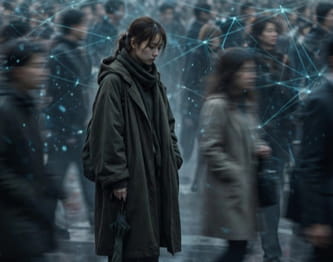
That growth coincides with the so-called "loneliness epidemic": The number of Americans with no close friends quadrupled from 1990 to 2021. Men have been hit hardest; 1 in 5 single men report having no close friends at all.
Danny Metz, a 28-year-old who works in insurance, tried BFF out. He swiped right on guys who seemed cool and better-looking than him. But the idea of meeting up with a match felt weird. Metz deleted the app. "I’m too used to this behavior for dating girls," he says. "I’ve only ever organically made a friend."
But that’s not so easy. As far back as 2000, Robert Putnam argued that technological isolation, urban sprawl and the disintegration of civic organizations had eroded social capital in his book, "Bowling Alone." The settings for making friends have only grown fewer in the years since.
Even in the settings that do remain, casual conversation has disappeared, says historian Sarah McBride. McBride, who teaches a class on friendship at the University of California at Berkeley, noticed her students would look at their phones before lectures began. "It created a bubble with themselves and their technology. They’re not having those spontaneous 'I like your jacket’ or 'What book are you reading?’ conversations that can spark friendship in real life," she explains.
Students told her they worried about surveillance. "Students felt nervous interacting with a stranger. If they were filmed, they could be made viral against their will, memed or put on TikTok," McBride says. "Low-stakes interactions with people can be the beginnings of new friendships. But students are fearful of it, worried they might be put on the internet."
Sara Rollens, 32, had tried to make friends in real life. On the way to a book signing, she recalled thinking, "I’m gonna go. I’m gonna meet friends." But when she arrived, she found the other attendees to be shy. "You’ll walk up to people to say hi, and they get really freaked out," Rollens says. "People have a hard time conversing in real life."
She turned to a friendship app but discovered they had many of the same pitfalls associated with online dating: She has deleted and redownloaded BFF over the course of four years. She’s rejected men who hoped the friend dates would turn romantic and women who hoped Rollens would join their multilevel marketing schemes. She’s been platonically love-bombed by matches. She was even ghosted by one person after three dates.
Rollens has made a few acquaintances but no deep friendships. She stays on the app, she says, "just in case" it can work.
Eric Balki, who researches dating app algorithms at the Faculty of Health and Medicine at Lancaster University in England, says that much like dating apps, friendship apps "are designed to keep you on there. The business model is misaligned to the demand."
If matches were optimal, he notes, users would leave the app. "It ends up making you more lonely and defeated," he says.
He compared algorithmic matching to slot machines. Every once in a while, there is a random small reward, which maintains a user’s expectation for a larger reward to come. And some users do achieve that larger reward. They find a best friend forever. The news spreads - the bell ringing is loud. Slot machines can pay out, so users return.
Bumble says that it encourages in-person interactions, via events and "Groups" built around hobbies and interests. "We know people are craving real-world connection and more opportunities to spend meaningful time together in person. What we’re seeing on BFF reinforces that desire," a Bumble spokesperson told The Washington Post.
The group Curi met stayed friends for a while. They partied together over Halloween, watched "The Bachelor" and played board games. Then two had a falling-out over a man, and another took a job far away. The friendships fizzled.
When Curi, now 27, moved to San Diego, she decided to try again. This time, Curi set up a profile on Timeleft. She recalled answering questions like, "Do you like lighthearted people or people that align with your values?" Then the app matched her with five strangers and sent them to dinner together at a local Italian restaurant.
"That one I was really nervous for," she says. The group didn’t have one another’s names, much less contact information, and couldn’t communicate ahead of time. Curi’s hair was back to its natural brunette. She wore a pencil skirt as a tube top and paired it with baggy jeans and sandals.
She didn’t click with the women at her table. "I didn’t feel like anyone was a great match or a good friendship," Curi says. "They had a lot of questions about [my] queerness and coming out, and then they asked me about my tattoos. Nobody had tattoos. Nobody had talked to a gay person."
She overheard the table beside her, a group also formed by Timeleft. That table’s guests were closer to her own age. They talked about shows and bars Curi liked. "They were having so much fun, and I was like, 'Damn, I wish I could meet them,’" she says.
Then serendipity struck for Curi. The app sent an address of a karaoke bar for an optional, after-dinner cocktail hour. All the Timeleft tables were invited. Once she arrived at the bar, Curi jumped ship and made friends with the users she’d been eyeing at dinner.
A year and a half later, they play trivia, celebrate birthdays, try new restaurants and watch "Love Island" together. She’s still friends with all of them, and they hang out at least once a week.
(COMMENT, BELOW)
Every weekday JewishWorldReview.com publishes what many in the media and Washington consider "must-reading". Sign up for the daily JWR update. It's free. Just click here.