



 Contact The Editor
 Articles By This Author
After winning commanding majorities in Congress in last week's midterm elections, Senate Minority Leader Chuck Schumer (D-New York) and House Minority Leader Hakeem Jeffries (D-New York) might have expected little opposition to their efforts to continue guiding their party on Capitol Hill.
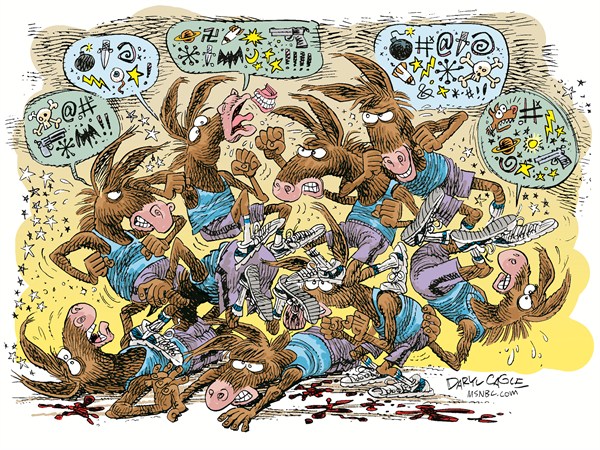
Instead, the two Democratic congressional leaders are beating back campaigns by progressive activists - and some of their colleagues - to oust them.
For now, neither effort appears likely to succeed, given the inherent challenges of persuading a majority of the Democratic caucuses to change direction on short notice following major political victories. Many members have already expressed their support for Schumer and Jeffries.
But liberal advocacy groups, boosted by high-profile figures like actor Mark Ruffalo, are organizing against the two men, and some congressional offices say they have received hundreds of phone calls from constituents demanding new Democratic leaders.
Their message is now reverberating through the Capitol, where on Tuesday, Sens. Bernie Sanders (I-Vermont), a progressive who caucuses with the Democrats, and Elissa Slotkin (D-Michigan) held a joint news conference to declare they would not support Schumer for majority leader. Both said the party should have an open debate about how best to lead the country in a new direction.
"This idea that it's progressive vs. moderate is just very 2019. It's team fight vs. team flight," Slotkin said. "Do you actually want to fight hard for the things that are going to help people or do you kind of want to just sit there and look like you're doing something?"
Sen. Chris Van Hollen (D-Maryland), a progressive favorite, has signaled he is open to challenging Schumer but has not yet declared he is running. In the House, a handful of incoming lawmakers have refused to commit to voting for Jeffries as speaker, though no alternative candidates have emerged.
Critics argue Schumer and Jeffries are the wrong leaders for the moment. The two have been lambasted by progressives activists as ideologically out of step with their own party: too closely aligned with corporate donors as populism is on the rise, too supportive of Israel and too weak to effectively oppose President Donald Trump in his final two years in office.
"Voters just gave Democrats a huge mandate. It was a vote for change from Trump, but it was also a vote for change from the status quo," said Saikat Chakrabarti, the progressive activist who helped launched the career of Rep. Alexandria Ocasio-Cortez (D-New York). He has been posting to his tens of thousands of followers on social media every day about replacing Schumer and Jeffries.
Despite decisively flipping the Senate - where Democrats now have 54 seats and lead in two more uncalled races - Schumer faces a growing resistance. Though the effort is largely led by the party's grassroots, the International Association of Machinists union on Monday called on Schumer to step aside.
"Americans want to see leadership. They want to see a willingness to take on concentrated power and corruption," said Leah Greenberg, the co-founder and co-executive director of the progressive group Indivisible. "In order to do that, we can't use the same old same old."
Indivisible has been urging its members to call their senators and ask for an open process to choose a new leader.
Greenberg said there is more urgency around the Senate because of the filibuster, which creates an obstacle to Democratic priorities that does not exist in the House. In addition to abolishing the filibuster, Greenberg said the next Senate leader must commit to ending the Iran war and clawing back billions of dollars in new funding for immigration enforcement that Republicans approved earlier this year so that it can be redirected to health care programs.
Schumer has continued to project confidence that he will be elected majority leader. Democrats will choose in secret and Schumer needs only a simple majority of the caucus. The full chamber has no say on his job.
"We have great unity in our caucus, and I'll be proud to lead it as majority leader," Schumer said during a news conference Tuesday, shortly after Sanders and Slotkin called for new leadership.
He has plenty of supporters, such as Sen. Mark Kelly (D-Arizona), who said Tuesday that Schumer "worked really hard to get the majority back."
Sen. Kirsten Gillibrand (D-New York), who alongside Schumer led Democrats' efforts to retake the Senate, delivered a forceful defense of their massive wins.
"That takes vision. It takes clarity of thought. It takes strategic leadership. And that is what Sen. Schumer has done," she said. "That is why you will see, despite all the grumblings, enormous gratitude for the hard work he has done to get us to this position."
But some newly-elected senators from across the ideological spectrum - including Troy Jackson (Maine), Annie Andrews (South Carolina) and Adam Hamilton (Kansas) - have publicly said they will not vote for Schumer for majority leader, fueling hopes among progressive activists that there is a path to defeat him.
Many of those activists are now rallying around Van Hollen and encouraging him to formally challenge Schumer. Sen.-elect Abdul El-Sayed (Michigan) has said he would support Van Hollen if he runs.
It's rare for a Senate Democratic leader to face a challenger. A group of senators opposed Harry M. Reid, the late Democratic Senate leader from Nevada, after Democrats lost the majority in 2014, but he held onto the position.
Van Hollen, a progressive who spent 14 years in the House before he was elected to the Senate in 2016, has said the selection of a majority leader should not be a "coronation." In an interview, he said he is "now very actively in listening mode" and talking to his colleagues about whether to run against Schumer.
"This is about really responding to the calls of the country," said Van Hollen, who is also weighing a bid for president in 2028. "People are asking themselves how best do we accomplish that."
Jeffries has faced a restless Democratic base for months. After progressive challengers began upsetting incumbents in primaries this summer, some spoke about withholding their support from him to extract concessions or even deny him the speakership in a potentially closely divided House. The New York Times reported in August that Jeffries secretly met with Trump's son-in-law and political adviser Jared Kushner, further fanning liberal discontent.
Then Democrats blew past expectations last week. They have already won 255 seats in the House and lead in seven races that have yet to be called.
Jeffries "has earned the right to lead us," Rep. Debbie Dingell (Michigan) told reporters on Tuesday.
House Democrats are scheduled to vote next week on a Democratic nominee for speaker, and Jeffries would need a simple majority to prevail. When the full House chooses a speaker in January, Jeffries needs 218 votes - meaning probably more than 40 Democrats would have to defect to deny him the position.
So far, only a small number have indicated they might. Rep.-elect Angela Gonzales-Torres of California said Monday that she is currently a no because her community voted for change. Rep.-elect Richard Ojeda of North Carolina is demanding a vote on legislation to overturn the Supreme Court's Citizens United decision on campaign finance before he will agree to vote for Jeffries.
Chakrabarti said he's spoken to other members who privately wish for an alternative to Jeffries but will vote for him because he has no credible challenger.
"We don't need a credible challenger right now," Chakrabarti said. "We just need to make sure Jeffries doesn't win."
As Congress returned to Washington this week to welcome newly-elected members and resume business, Jeffries dismissed the threat to his leadership.
"I'm very confident we'll get there," he said at a news conference. Walking into his weekly leadership meeting, where he was greeted with cheers, Jeffries added, "We're talking to everybody, and I look forward to the vote next week."
(COMMENT, BELOW)