



Life Imitating Art?
NASA hit an asteroid to test planetary defense. Here's what happened

By Meghan Bartels The Washington Post
Published Nov. 26, 2026
 Contact The Editor
 Articles By This Author
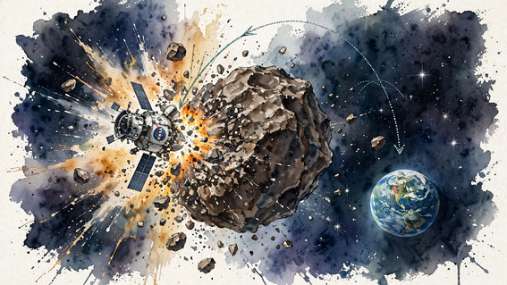
Four years ago, NASA slammed a spacecraft into a tiny space rock to send a message to any asteroids that might threaten a collision with Earth: Don't mess with humans. Now, scientists have confirmed that message was even more powerful than they already knew - the mission designed to test a technique for diverting an object hurtling toward our planet didn't just move the demonstration target; it also left it utterly transformed.
The incredible extent of the damage was revealed Wednesday with the release of stunning new images of the maltreated little asteroid Dimorphos and its larger companion Didymos. Animations show that chaos continues to rein in the aftermath of NASA's collision, while initial views of the surface of Dimorphos show a landscape completely unlike the one seen during the collision itself.
"Most of what we saw is now gone," said Sabina Raducan, a planetary scientist at the International Space Science Institute in Switzerland and Vrije Universiteit Brussels in Belgium, during a news conference Wednesday. Replacing the rock-strewn landscape scientists once saw is a crater nearly as large as Dimorphos, with a strange rodlike rock revealed at its center.
The images were collected in a separate mission conducted by the European Space Agency's Hera mission, which arrived last month at the asteroid NASA targeted.
"The results are beyond what we could expect," said Patrick Michel, a planetary scientist at the French National Center for Scientific Research (CNRS) and principal investigator of the Hera mission. "They are astonishing."
NASA's Double Asteroid Redirection Test (DART) mission slammed into Dimorphos in September 2022, and within months, scientists confirmed that the mission successfully shortened the moonlet's orbit around the larger asteroid Didymos by 32 minutes. Those results from planetary defense efforts were more than enough to prove that humanity can indeed deflect an asteroid, should the threat be detected soon enough.
But that calculation offered only a superficial understanding of how NASA's impact changed the binary asteroid system. In order to confidently tailor any necessary asteroid deflection attempt in the future to the details of the threatening space rock, scientists need to have painted a mathematically intricate picture of the DART impact.
That's where Hera's extended mission to Dimorphos comes in.
"Hera gives us an opportunity to really just tie a bow around it and understand what happened - to complete the DART experiment," said Angela Stickle, a planetary scientist at Johns Hopkins University's Applied Physics Laboratory who is affiliated with both missions.
But it won't be easy. The Hera team has discovered that Dimorphos is surrounded by hundreds of free-flying boulders zipping within about six miles of the asteroid. The scientists knew such objects were a possibility and were prepared to navigate around hazards, but there are many more than they expected. Mission personnel must now track each boulder's orbit to keep the spacecraft safe - and to figure out whether the debris stems from the collision or something else.
"Hera came to visit two asteroids, and we've found hundreds of companions," said Naomi Murdoch, a planetary scientist at ISAE-SUPAERO in France, during the news conference.
Meanwhile, the mission's scientists are also working hard to map the current state of Dimorphos. DART got only got a quick glimpse of the asteroid as the spacecraft sped toward its demise, so scientists don't have much to compare the new images to, but Hera has unveiled what looks to be practically a whole new asteroid.
"We were always talking about maybe we reshaped it or maybe we made a crater, and in fact what the images reveal is that we have done both," Michel said. "We have a huge crater, which makes you wonder how the body survived." As the mission unfolds, Hera will construct a much more detailed map of the crater and even peer beneath the asteroid's surface, which should give scientists a better handle on why the DART scar is so vast and what it means for potential future deflections.
Hera has also confirmed that the collision brought chaos to the little moonlet's orbit, sending it tumbling and rolling instead of smoothly rotating and revolving around the larger Didymos.
"We gave it a really big kick," said Terik Daly, a planetary scientist at the Applied Physics Laboratory who was on the mission team for DART but is not for Hera. Seeing that Dimorphos hasn't settled back into an orderly movement and understanding the exact state of destabilization that remains four years after impact is another piece of the planetary defense scouting scientists need to do.
A final key for fleshing out the DART collision and informing any future deflection attempts will be measuring the total mass of Dimorphos. Hera offers several complementary techniques for that task, with estimates already in the works and calculations likely to be among the mission's first published results.
Those gory details are keeping the Hera team very busy, and will continue to do so. Although the new images are the mission's first big reveal, there's much more to come. In December, the spacecraft will creep closer to Dimorphos; in January, it will release two tiny companion satellites to conduct their own observations and even land on the little space rock.
"From now on, every month we have a risky operation - and new science," Michel said.
(COMMENT, BELOW)
Every weekday JewishWorldReview.com publishes what many in the media and Washington consider "must-reading". Sign up for the daily JWR update. It's free. Just click here.