



 Contact The Editor
 Articles By This Author
A handful of moderate Senate Democrats are considering voting to end what has now become the country's longest government shutdown, splitting the caucus as some colleagues to their left urge them to hold out for a better deal.
A bipartisan group of senators is working to craft an agreement in which Congress would pass three full-year appropriations bills to fund some agencies, along with a short-term bill that would reopen the rest of the government, according to four people familiar with the talks, who spoke on the condition of anonymity to describe private discussions. In exchange, Senate Republicans would agree to hold a vote at a set date on extending Affordable Care Act subsidies that are otherwise slated to expire. Democrats have insisted throughout the shutdown that the subsidies be extended.
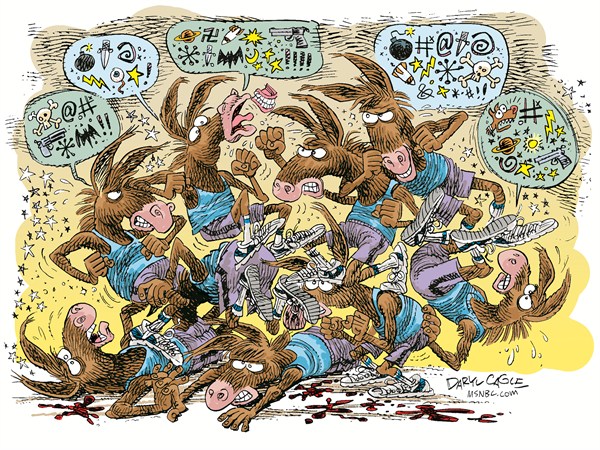
About a dozen Senate Democrats are open to backing the proposal, three of the people estimated, which is still being hammered out - more than enough to break the impasse and reopen the government. But Democrats' victories by double-digit margins Tuesday in the races for governor in New Jersey and Virginia - which President Donald Trump attributed in part to voters' dissatisfaction with the shutdown - renewed calls on Capitol Hill for the party not to settle for what Republicans are offering.
Sen. Bernie Sanders (I-Vermont), who has urged Democrats for days not to cave to GOP pressure, said the election results showed that voters want Democrats to press for lower health care costs.
"What people want is for the Democrats to stand up and continue to fight," Sanders told reporters.
Senate Minority Leader Charles E. Schumer (D-New York) described the election results "a bolt of lightning and a wake-up call to Donald Trump to start working with us" to extend ACA subsidies.
"Last night should make it clear to Republicans that they simply cannot continue to ignore not only us but the American people," Schumer told reporters.
Trump told Republican senators Wednesday that the shutdown was "a big factor" that hurt the party in Tuesday's elections. But rather than encourage bipartisan talks, Trump pressed Republicans to eliminate the filibuster to allow them to reopen the government without Democratic votes - an idea that Senate Majority Leader John Thune (South Dakota) and other Republicans have rejected repeatedly.
The government has been shuttered since Oct. 1, when funding ran out and Congress failed to agree on a funding extension. Democrats have demanded Republicans work with them to extend pandemic-era ACA subsidies that will expire at the end of the year, raising health care premiums, in some cases sharply.
Republicans have refused, saying they won't negotiate on health care while the government is shut down. They have repeatedly offered a bill that would fund the government through Nov. 21, which Senate Democrats have defeated 14 times.
But as food aid remains uncertain, flight delays mount and federal workers continue to miss paychecks, some moderate Democrats are looking for a way out of the impasse.
Senate Democrats met for lunch Tuesday for nearly three hours to discuss the path forward. Those involved in the talks updated their colleagues on where they stand. Afterward, Sen. Gary Peters (D-Michigan), who has been part of the negotiations, said it was a "thoughtful" discussion: "It was one of the better caucus meetings I've been in in a while."
Democratic senators will meet again Thursday.
Republicans who have been seeking to persuade Democrats to end the shutdown argue that a vote on a handful of appropriations bills could provide enough cover for them.
"They're tired of this. So if they can see a path forward, such as something more than just a vote up or down on ending it, that gives them another reason to vote for something," said Sen. Mike Rounds (R-South Dakota).
Republicans, who control the Senate 53-47, need the support of at least eight Democrats to reopen the government because Sen. Rand Paul (R-Kentucky) opposes the bill and it will take 60 votes to break a filibuster. Sens. Angus King (I-Maine), Catherine Cortez Masto (D-Nevada) and John Fetterman (D-Pennsylvania) have voted for the Republican funding bill.
Some Democrats are more ready than others to strike a deal in coming days. Sen. Dick Durbin (Illinois), the No. 2 Senate Democrat, noted after lunch Tuesday that there were "differences of opinion" among his colleagues on what to do.
Some Democrats are urging their colleagues not to agree to reopen the government without a concrete agreement to extend the health care subsidies, rather than a promise to hold a vote. Sanders said Wednesday that Democrats should insist House Speaker Mike Johnson (R-Louisiana) and Trump endorse the subsidies before they vote to reopen the government.
Sen. Peter Welch (D-Vermont) described Democrats' victories on Tuesday as "wind at our back."
"This whole shutdown is about Trump's insistence on letting health care premiums explode, so [the election results are] an affirmation to us that we're doing the right thing by fighting for health care," Welch said Wednesday.
Sen. Lisa Murkowski (R-Alaska) said she thought the election results had made some Democrats more reluctant to accept a deal that doesn't deliver everything they want.
"I think some of them are looking at this and saying, ‘Okay, shutdown was tagged on the Republicans,'" Murkowski told reporters. "‘We just saw evidence there. So maybe we have a better bargaining position.'"
House Minority Leader Hakeem Jeffries (D-New York) and Schumer renewed their demand Wednesday for Trump to meet with them, which the president has ruled out until the government reopens.
Jeffries told House Democrats on a caucus call Wednesday afternoon that they will continue to "urge the Senate to stay the course and hold the line" and said that Tuesday's election was an "affirmation" that Democrats are on the right side of the issues, according to a person on the call, speaking on the condition of anonymity to describe a private conversation.
In another sign of Democratic confidence, Rep. Chrissy Houlahan (D-Pennsylvania) interrupted Johnson's daily press conference Wednesday to ask if he was ready to negotiate.
"I'm asking if you're ready to have conversations with the other side," she yelled from behind stanchions where reporters were standing outside of the Capitol. "You have an obligation to call the leadership on both sides and bring them together."
More Americans blame Trump and Republicans for the shutdown than blame Democrats, a Washington Post-ABC News-Ipsos poll found last week.
Democrats warn that millions of Americans who received the subsidies will see their insurance premiums rise unless the subsidies are extended in coming weeks.
That's causing some members of the caucus to balk at a possible deal that does not guarantee the subsidies will be extended. Sen. Ruben Gallego (D-Arizona) said he wouldn't vote to end the shutdown "unless there's somehow assurances that insurance rate premiums aren't going to double for 24 million Americans."
The idea that "we should have some level of trust that they're going to deal with us and deal with the American people in an equitable way, I think, is just laughable," he said.
"I'm unwilling to accept a vague promise for some vote at an indefinite point in the future on a bill yet to be determined," said Sen. Richard Blumenthal (D-Connecticut).
Republicans have said any bipartisan deal would require extending funding levels into December or January, rather than November, but senators disagree on how long the measure should last.
More than 650,000 federal workers have been furloughed since the shutdown began, and an additional 600,000 have been forced to work without pay. Many of those workers are struggling to make ends meet as bills come due after two missed paychecks.
Funding for the Supplemental Nutrition Assistance Program - known as SNAP, or food stamps - is in flux, jeopardizing food security for millions of Americans. A court ordered the Trump administration to fund November SNAP benefits. White House press secretary Karoline Leavitt said the administration is "fully complying" with the order, even though Trump posted on social media Tuesday that SNAP benefits "will be given only when the Radical Left Democrats open up government."
Transportation Secretary Sean P. Duffy on Wednesday announced the administration will reduce flight traffic by 10 percent in 40 markets across the country to ease pressure on air traffic controllers. He warned earlier this week of "mass chaos" in the skies if the government shutdown drags on, potentially causing air traffic controllers to skip work as they continue to miss paychecks.
Staffing shortages have already caused flight delays across the country.
(COMMENT, BELOW)
Every weekday JewishWorldReview.com publishes what many in the media and Washington consider "must-reading". Sign up for the daily JWR update. It's free. Just click here.