



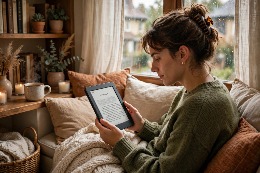
Fantas-Tech?
What you miss when you read on a screen

By Michael J. Coren The Washington Post
Published October 19, 2026
 Contact The Editor
 Articles By This Author
A reader asks: I am a voracious reader. My books are downloaded to my e-reader. Is there a downside? Should we all go back to traditional paper books?
For the record, I love all books, digital and paper. Unlike my children, I love them differently.
I naturally gravitate toward buying paper books I expect to love. These end up in my home library or passed along to friends and family (the lack of true ownership is the most enervating thing about e-books).
When I just want information, however, e-books deliver. They're fast, affordable and - crucially - easy to search when I need to recall information or unearth a point on deadline.
Is one format superior as a reader? For me, it's a matter of using the right tool for the job.
Let's set aside tablets with a backlit, full-color screen like an iPad. While remarkably versatile, these are essentially big smartphones, with all the distractions that brings. Reading on a screen of that kind within one to two hours before bed keeps you up longer, reduces deep REM sleep and leaves you groggier the next morning, scientists find. Your comprehension of what you're reading may also suffer, a phenomenon known as the screen inferiority effect.
Dedicated e-readers, which use tiny capsules of physical pigment to display words and pictures, function much more like paper. Even with the backlight on, its dimmer light shines across the screen, rather than at your eyes, reducing eyestrain and sleep disruption. When researchers looked for physical or psychological drawbacks of e-ink, they found few. Past studies have found that e-reader owners read more, but it may be that heavy readers seek out the devices, not that they transform people into bookworms.
So far, so good. But e-readers are not merely more convenient simulacra of print books. The screen inferiority effect is most prominent with tablets but affects e-readers too, at least in certain contexts.
Screens affect how we understand and remember texts. The scrolling or shifting pagination removes the "topography" of print books: the spatial and tactile landmarks from the experience of turning, feeling and reading paper pages. On average, scientists find many readers comprehend and recall slightly less information than when reading the exact same text on paper.
This is particularly true of denser or more challenging nonfiction work, especially under time pressure, compared to lighter, linear narratives. But it's not absolute: Skilled readers and digital tools - such as highlighting and marginalia - can mitigate some of these losses.
Paper, by contrast, invites slow, deeper focus and reflection. You can create landmarks in the margins of a work - I add a small dot with pencil by passages I plan to revisit - that is always ready to be pulled off the shelf. That's much more readily at hand than an e-book buried in a folder on your device.
Finally, once it's in your hands, you own a paper book. For e-books, you merely hold them. Many publishers license books, rather than truly sell them to you. After a licensing dispute in 2009, Amazon remotely deleted an unauthorized edition of George Orwell's "1984" from customers' devices. (Amazon has since agreed to limit the practice; its executive chairman, Jeff Bezos, owns The Washington Post.)
Here's my simple heuristic for navigating the digital vs. paper dilemma: If you want a convenient, customized and portable reading experience for lighter reading, e-readers are the way to go. Fiction, light nonfiction, travel, and library loans (via apps like Libby or OverDrive) are especially well suited to digital reading. I use a Kobo because it treats me better than my Kindle.
But if you want to savor a book for beauty or bedtime reading, or wrestle with new ideas, print remains the superior technology. I'm not alone. Americans still choose print, says Pew Research Center, over any other book format.
If you're looking for a great read, I just started "Jericho River," a novel by Gus Speth, former dean of the Yale School of the Environment, on what a small town teaches us about how to live together.
From Mike's Notebook
Video is taking over from text. The data is clear. People are spending more and more time on oral and visual stories, mostly podcasts and short-form video, while devoting less and less to books. We aren't yet a postliterate society but our abandonment of deep reading could be, as James Marriott argues in his book "The New Dark Ages," a threat to democracy, eroding many of the gains from the Enlightenment.
Looking around, it's hard not to wonder whether the collapse of a shared reality, or recognition of empirical facts and reasoned arguments in mainstream culture, is a structural consequence of the shift from books to algorithmic audiovisual media.
Which brings me to the distraction in my pocket. My recent column on Tuesday was about breaking your digital addictions and putting some distance between yourself and your smartphone. But beyond delivering a faster burrito, can smartphones improve our interior lives?
I argued that you should make your phone worse on purpose. You had suggestions.
"I switched to a Light Phone and, while it doesn't work as well as it should, I find myself much happier for it," said one reader. Another reader deleted every game on their phone after spending too much time playing: "One of the best things I've ever done for myself." Louise in Boston said the best thing she did was delete social apps. "I can still look on my laptop, but I almost never do," she wrote - a tactic I use myself. "Of course, I had to leave journalism first …"
My favorite idea, "sounds crazy," wrote one reader, "but state out loud (or under your breath) WHY you are about to look at your phone before you pick it up." I bet that will drastically cut anyone's phone usage.
Other readers noted that their phone still rules them. "It manages me," wrote one. "On first thing in the morning, off last at night and I find myself looking at it while riding in the car instead of talking to my husband & or looking out the window. I check my email way too often! Maybe I should unsubscribe to all the WaPo notifications?" Mea culpa.
Kathy, however, was an unapologetic dissenter. "I'm addicted to my iPad, not my iPhone," she wrote. "I love my iPad full of good stories and photos and shopping and social media. I openly admit it and not ashamed. It's better than TV."
(COMMENT, BELOW)
Every weekday JewishWorldReview.com publishes what many in the media and Washington consider "must-reading". Sign up for the daily JWR update. It's free. Just click here.