



Excuse My French
Riots leave France divided as Macron enters his final stretch

By Ellen Francis The Washington Post
Published October 21, 2026
 Contact The Editor
 Articles By This Author
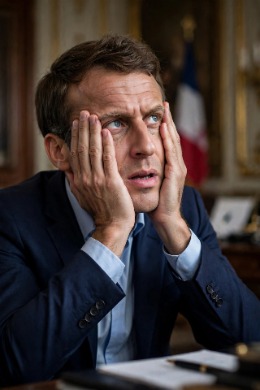
PARIS — Less than 48 hours after French cities were swept by protests, then engulfed in riots that left cars burning and shops smashed, President Emmanuel Macron set off for the Persian Gulf.
To his critics, it looked like an escape. Political commentators on RTL radio debated the question: "Is there still a pilot on the plane?" French daily La Dépêche was scathing in a Tuesday editorial that said Macron "went to see if the misery of a reviled president is less painful in the Persian Gulf sun."
After a televised address to the nation Sunday night, even as Macron sought to convey that he understood concerns over the soaring cost of living, business owners and union officials said they saw a checked-out president.
In his final run in office and facing bitter divisions ahead of next year's presidential election, Macron said he would stick to the planned Gulf trip to help bring down fuel prices. Those costs, compounding on others, have animated many of the protesters. He said energy prices were driven up by a war France did not seek, in yet another example of President Donald Trump's war against Iran complicating politics for leaders around the world.
Macron's office said Tuesday that he had secured the supply of an extra 200,000 tons of diesel a month from the United Arab Emirates and Bahrain to help tame prices and "strengthen our energy security."
While the rise in energy prices may be new, the roots of France's fiscal woes and political paralysis predate even Macron's mandate. They have culminated in swaths of society demanding a better life from a state that is increasingly tight on funds and burdened by debt. More than half a million people marched in the streets Saturday after weeks of demonstrations.
The protests gave way to nighttime rioting and looting that projected an image well beyond France of a state losing control of its public finances and its streets.
At Place de la République in Paris on Tuesday, workers were cleaning up graffiti, including calls for Macron to resign. Stores were boarded up, and some shopkeepers were making repairs to their shattered facades.
Sylvie Calvi, owner of a specialty grocery store nearby, said the scale of the weekend's violence had unnerved people in her neighborhood. But, she said, many were also racked with worries of political or financial uncertainty, beyond the unrest.
"This is preoccupying the citizens. I don't know how much it's preoccupying the politicians," she said. "They don't seem to have many solutions, unfortunately, and I think that people have had enough."
French Prime Minister Sébastien Lecornu, who has vowed to reassert control, said Tuesday that curfews in parts of Paris and other cities are returning calm, and some would be extended.
France's leaders are contending with forces of discontent and dissent that are sweeping through some of their neighbors, too, ahead of several upcoming European elections.
Protests gripped parts of Italy, Belgium and Spain in recent weeks over an array of concerns, many also linked to affordability, housing costs, energy prices and school funding - albeit to a smaller and less explosive degree.
In France, police detained around 2,500 people after rioters ransacked stores in Paris, torched a historic town hall in Limoges and clashed with police from Lille to Marseille.
At the core of France's troubles is the seeming imperative that the country scale back public spending, and the painful question of where and who the attendant cutbacks would hit.
The tensions are festering in the street but also in a presidential race that will determine Macron's successor, and with it, a pillar of the European political landscape.
Two of the main candidates have seized on the chaotic scenes for their campaign: Marine Le Pen of the hard right and Jean-Luc Mélenchon of the hard left.
As politicians descend into finger-pointing, Le Pen, who is leading in the polls, has portrayed a nation stuck between a powerless leadership and a radicalized left, with her as the sensible choice.
Le Pen, whose National Rally party is seeking to prove it can move from its history on the extremist fringes into the halls of power, sat at a desk with the French flag behind her in a video telling the French people that soon, they "will be able to choose a different path."
While Le Pen focuses blame on her political rivals, Trump administration officials, along with right-wing politicians in the United States and in some European countries, have jumped on France's chaos to pin it on migration.
All the while in France, government officials and even Le Pen's anti-immigrant party acknowledge a sense of economic injustice riling people across the political or social spectrum.
"Le Pen is floating on a cloud of French - and also more widely European - rejection of mainstream politics, which the riots will reinforce," noted Mujtaba Rahman, managing director for Europe at the Eurasia Group consultancy.
He said the unrest damages "much of what remained of Macron's domestic credibility," and could hurt the chances of center-right presidential hopeful Edouard Philippe, a former prime minister under Macron, "by association."
Government officials have accused Mélenchon and "ultraleft" groups of drumming up violence for political gain ahead of the election.
Mélenchon's party, meanwhile, blames the government for failing to respond to the frustrations of people protesting high prices, budget cuts, pressure on public services and other grievances with Macron's administration.
"This is about how the country spends its wealth," and whether debt is funding pensions, schools or technology, for example, said John Goodman, director of Syracuse University Strasbourg. "That's a very hard conversation to have with the nation six months before a presidential election."
France's main candidates each proclaim to have the solution, though none are rushing to campaign on curbing the country's social benefits system - a step the government is trying to take, describing it as unpopular but necessary.
The Euroskeptic Le Pen has stoked anxiety in Europe's embattled mainstream leadership by vowing to cut France's contribution to the European Union's budget and the country's financial aid to Ukrainian forces fighting Russia.
On the far left, Mélenchon, a divisive veteran of French politics, has clashed with the central bank governor and declared plans to cancel a big chunk of the country's debt as president.
In keeping with French custom, Macron has cast himself as above the fray of fractious domestic politics and asserted himself on the global stage. But the approach has at times drawn criticism of being out of touch with people.
Macron's two terms have had their ups and downs, and in many moments he appeared to be more celebrated abroad than at home. Since Trump's return to power, the French president has received a resounding endorsement in Europe for his longtime call for greater autonomy from Washington.
Yet in France, Macron, a former investment banker who billed himself as an alternative to the left and right, appears to have lost voters on both sides, many of whom are fatigued or polarized by chronic crisis, analysts and officials say.
Even some from the president's camp cast the latest turmoil as a sign of waning authority in the face of popular anger ― or, as lawmaker Loïc Kervran put it: "The end of this term is a slow agony."
(COMMENT, BELOW)
Every weekday JewishWorldReview.com publishes what many in the media and Washington consider "must-reading". Sign up for the daily JWR update. It's free. Just click here.