



Small World
Russia, China and Iran Harness AI for US Midterm Disinformation

By Natalia Drozdiak Bloomberg
Published Oct. 15, 2026
 Contact The Editor
 Articles By This Author
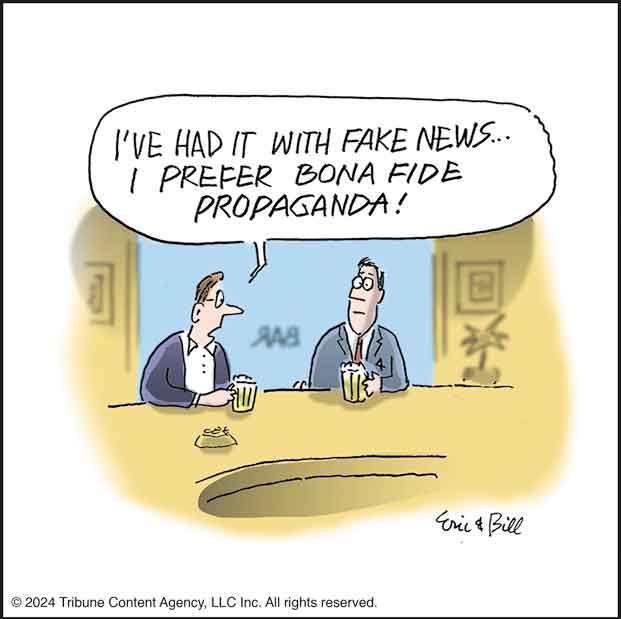
Russia, Iran and China are using artificial intelligence tools to turbocharge disinformation efforts ahead of the midterm elections, according to people familiar with US intelligence and independent researchers.
US adversaries have been using generative AI software, such as OpenAI's ChatGPT and Anthropic PBC's Claude, to easily plan large-scale propaganda campaigns aimed at sowing division and swaying political outcomes abroad. US officials and researchers are now concerned malign actors could use those same tactics to target the Nov. 3 midterms, although it wasn't clear they were currently doing so.
There is also concern geopolitical rivals could try to groom AI chatbots to influence what shows up in AI-assisted search queries, making disinformation appear more legitimate. Russia has been the most aggressive in its online campaigns around the US midterms so far, with China and Iran also active, two of the people said, speaking on condition of anonymity to discuss analysis that wasn't public.
While malign actors have long used AI tools to create fake news, disinformation and deep fake videos, huge advances in generative AI technology pose a new challenge for the US and other nations.
"These tools can help foreign actors plan their operations, identify audiences to target, and figure out how to make their interference more effective," said Senator Mark Warner of Virginia, the top Democrat on the Senate intelligence committee. "That's a significant evolution in the threat, and one we need to take seriously. We need to be thinking several steps ahead of our adversaries, not playing catch-up."
The influence campaigns are also increasing in sophistication at a time when the Trump administration has dismantled government programs to target those efforts, such as the FBI's Foreign Influence Task Force and the Office of the Director of National Intelligence's Foreign Malign Influence Center, arguing that they were curtailing free speech.
"As the capabilities have ramped up, we have ramped down," said Bret Schafer, the Institute for Strategic Dialogue's senior director of policy and research for information operations, referring to the US. "This feels like the time that we needed all hands on deck working on this new issue."
Online influence campaigns targeting US voters ahead of the midterms are already under way but there is no evidence foreign actors are targeting voting infrastructure or trying to meddle directly with vote counts, the people added.
The Russian Embassy didn't respond to an emailed request for comment. A spokesperson at the Iranian mission to the UN could not be reached when attempted by phone. A Chinese Embassy spokesperson said China is "opposed to the dissemination of disinformation for political purposes and the use of cybersecurity issues to smear China."
"The Trump administration is taking decisive action to protect our elections including prosecuting election crimes, strengthening election infrastructure security, and protecting vulnerable voters from fraud and coercion," White House spokeswoman Lauren Bis said in an emailed statement.
President Donald Trump has also repeatedly rejected US intelligence assessments about Russian efforts to help his 2016 campaign, though he used a prime-time address this summer to accuse China of interfering with US elections in 2020.
In their influence campaigns tied to the midterms, Russian actors have been trying to discredit individual US lawmakers who have supported Ukraine, while China-backed attempts have targeted specific races relevant to US-China policy, one of the people familiar with US intelligence said. Iranian attempts have tried to undermine faith in the US electoral system as a whole, the person said.
It's difficult to determine the possible effect on the midterms, in part because efforts may aim to sway voters on a broader topic, such as US support for Ukraine, rather than a specific congressional race.
But the biggest Silicon Valley firms have recently highlighted how their AI tools are being used to broaden the reach of disinformation campaigns, including in elections in Europe.
"We have evidence that this has been their strategy in Europe," Leah Siskind, an AI research fellow at the Foundation for Defense of Democracies. "Why wouldn't they be doing the same in the US?"
Anthropic has detailed attempts by Russian and Iranian actors to use Claude to build networks of fake social-media profiles, news sites and other deceptive content. In September, the AI company said it disabled accounts using Claude to create and distribute editorial content to Russian-state media, including amplifying fabricated claims about Moldovan President Maia Sandu ahead of the country's parliamentary elections in 2025.
OpenAI and Anthropic said company policies prohibit using their products to spread content to deceive people about elections and voting processes. Security teams at both firms regularly detect, disrupt and publish reports about foreign-influence campaigns and covert operations.
"Detecting and disrupting adversarial misuse of our models is a core priority for our investigations team," an OpenAI spokesperson said.
Last week, OpenAI said a Russian operation used ChatGPT to help establish a fake think tank and hire unwitting employees as part of a campaign to undermine Ukraine's reputation in Latin America, a drive that appeared to be aimed at influencing local political outcomes in the region.
OpenAI also said Iranian actors used AI tools to refine articles, editorial pitches and generate social-media comments focused on the Iran war, and in some cases on US politics, and successfully had them published by a dozen online news outlets around the world.
At the same time, CASM Technology, an information integrity laboratory, found Russian actors deliberately targeted AI chatbots - over traditional search - and got them to cite falsehoods from a propaganda group as legitimate in nearly 500 of 3,000 queries, according to a July report published by UK-based think tank Demos.
FDD's Siskind said the issue is more concerning now that more Americans are relying on chatbots. Roughly half of American adults now use chatbots, according to the Pew Research Center. Propaganda efforts can get an added boost in AI results because many mainstream media companies block websites from being scraped by AI for copyright reasons.
AI chatbots can also inadvertently pull propaganda directly from state-owned media or foreign government websites, especially when there isn't a lot of information on a particular topic, a trend highlighted by an Oct. 12 report from the Global Disinformation Index.
Schafer of the Institute for Strategic Dialogue said the real concern is how easy it is for malign actors to run an end-to-end campaign now using AI agents, which will do everything from reconnaissance to creating fake content to distributing it.
"It's going to make Russia, China and Iran better," he said.
The New York Times and the Washington Post were first to report on US intelligence analysis around foreign influence campaigns.
(COMMENT, BELOW)
Every weekday JewishWorldReview.com publishes what many in the media and Washington consider "must-reading". Sign up for the daily JWR update. It's free. Just click here.