



 Contact The Editor
 Articles By This Author
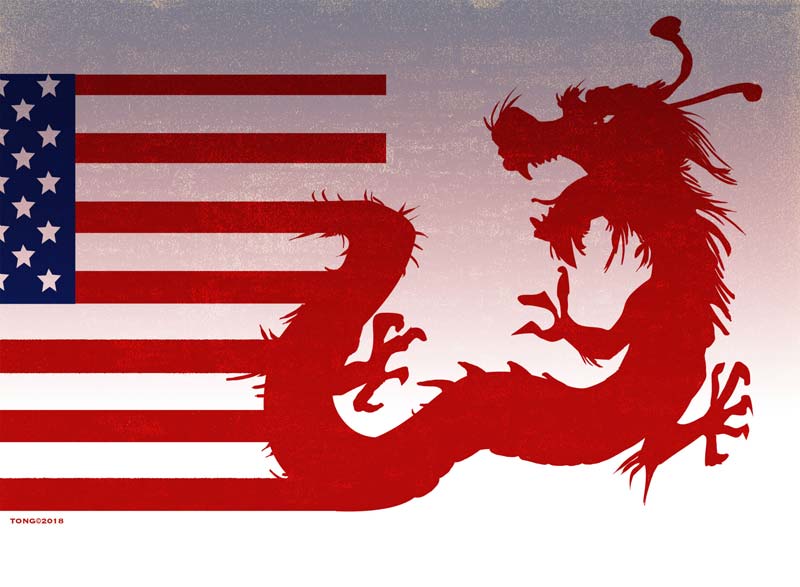
Silicon Valley leaders keep painting artificial intelligence doomsday scenarios, yet they also can't stop racing to build and sell it. They often point to China as the reason they have no choice, even as the post-ChatGPT era suggests the fiercest pressure comes from one another.
Yet the prevailing assumption is that cooperation with Beijing on frontier AI risks is impossible. It doesn't help that China itself is often viewed as the AI safety threat.
It all culminates in a terrible spot for the rest of us. But there is a narrow opening for something better. After a two-year halt in official AI safety engagement, the US and China said they would resume talks. The dialogue could come this month, Reuters reported, perhaps around the anticipated summit between Presidents Donald Trump and Xi Jinping.
What would count as success? Not trusting Beijing, and certainly not negotiating some package deal. The aim should be simpler. Each side needs enough visibility into what the other fears about AI's capabilities, and what it is doing to manage that, to keep suspicion from becoming an excuse for reckless acceleration. And just as crucial, the talks must be insulated from the rest of the US-China economic contest. Existential risks can't become bargaining chips.
Beijing has signaled its biggest concern ahead of discussion. Yuyuan Tantian, a social media account affiliated with state broadcaster CCTV, has warned that safety talks could become another attempt to contain China's technological rise. Having seen Washington invoke "national security" to justify blacklists and export controls, officials clearly fear that AI safety could become a similar tool for restriction.
Xi made this tension explicit in July, saying the world must "ensure that AI is always under human control" while opposing "overstretching the national security concept" and "placing one country's security over that of others." Beijing believes that who gets to write the rules as a leverage for geopolitical power, and is already proposing a World AI Cooperation Organization and backing two United Nations initiatives. The goal can't be getting China to accept US rules, but finding guardrails that both sides can live with that simultaneously tame internal race dynamics.
Beijing's approach to AI safety is also changing. Earlier regulation, still often cited as the centerpiece of its model, emphasized political controls. With the rise of agentic applications, the concern has shifted from what systems can say to what they can do, according to research group Concordia AI's annual report on the state of AI safety in China. The number of papers published in the country on frontier AI safety has grown substantially, with monthly output up roughly 60% from June 2025 to April 2026.
It means the challenge isn't convincing China to take the risks seriously, but persuading officials that AI safety is not another name for holding China back. Trust is unrealistic, but mutual visibility can be achieved.
Without it, leaders on both sides "will understandably assume the worst: that the other side is sacrificing any action on safety in a reckless race for building the most powerful system," Matt Sheehan of the Carnegie Endowment for International Peace writes. Safety calculations, he argues, will be driven by "self-interest."
Transparency is the obvious place to start establishing this. Hugging Face Chief Executive Officer Clement Delangue recently shared on X that he sometimes wonders what would have happened if they hadn't disclosed the OpenAI agent-related cyberattack. The episode has become the most recent warning shot for AI risks that are likely to grow as systems become more capable, gaining attention on both sides of the Pacific. It reveals that we need "100x more transparency in AI," Clement wrote.
Some of this sunlight can be shed not just via diplomacy, but through so-called Track 1.5 and 2 talks, more informal meetings bringing together officials in a private capacity or nongovernmental AI experts. Since 2023, Chinese and Western groups have held a dozen such discussions. Much more of them are needed to establish what each side is fearing and watching.
The official dialogue notably comes as advances in AI systems' ability to improve on their own is sowing new alarm. On Sunday, OpenAI's Chief Scientist advocated for "voluntary slowdowns" until "shared safety bars are established." Anthropic PBC similarly said in June that slowing development "would likely be a good thing," while acknowledging that any pause would be extraordinarily difficult to enforce.
Silicon Valley could stand to tone down the fearmongering if it has no intention to act on its warnings. Chinese companies, meanwhile, need to improve basic safety practices. Only five of 10 leading foundation model developers in China reported safety evaluation results alongside any release over the past year, according to Concordia. If Beijing wants to help set global rules, it should first demand more from its own industry.
Investors from both sides should push for the same. Avoiding catastrophe is essential to sustain confidence in the technology; a sharp reversal in sentiment would devastate markets at a moment when the global economy remains heavily exposed to the AI boom.
The best outcome from US-China AI safety talks will not be a sweeping accord that can be packaged in a flashy social media victory lap. Tariff truces and chip access shouldn't be bartered for promises on risks that know no borders. The real art of the deal is ensuring enough visibility — and enough self-interest — to keep both sides from racing in the dark toward a cliff.
Catherine Thorbecke is a Bloomberg Opinion columnist covering Asia tech. Previously she was a tech reporter at CNN and ABC News.