



 Contact The Editor
 Articles By This Author
President Donald Trump signed an executive order on Monday directing federal agencies to "vigorously prosecute" anyone who desecrates the U.S. flag, and to detain and revoke the visas of noncitizens who have been accused of such behavior.
The Supreme Court ruled in a 5-4 judgment in 1989 that burning the U.S. flag as a form of protest is a constitutionally protected right under the First Amendment. Trump in his executive order urged Attorney General Pam Bondi to find a case that could challenge that ruling. The majority of the court's justices now are more conservative than the court was back then, meaning there's a chance the president could prevail.
Here's what to know about the legality of flag-burning in the United States.
• What did the Supreme Court rule on flag-burning in 1989?
In 1984, Gregory Lee Johnson set fire to a U.S. flag outside the Republican National Convention in Dallas during a demonstration against nuclear war and Republican policies. He was sentenced to a year in prison and fined $2,000 for violating a Texas law against "desecration of a venerated object."
Johnson's case made it to the Supreme Court, which ruled that burning the flag was protected speech under the First Amendment. "We do not consecrate the flag by punishing its desecration, for in doing so we dilute the freedom that this cherished emblem represents," Justice William J. Brennan Jr. wrote in the majority 5-4 opinion.
Conservative Justices Antonin Scalia, who died in 2016 and whom Trump highly praised, and Anthony M. Kennedy, who retired in 2018, were among the majority. "It is poignant but fundamental that the flag protects those who hold it in contempt," Kennedy wrote in a concurring statement.
The ruling was controversial and nullified flag desecration laws in 48 states, The Washington Post reported at the time. Congress responded by passing a law criminalizing flag desecration, which the Supreme Court struck down.
Robert W. Spanogle, national adjutant of the nation's largest veterans' group, said after the 1989 ruling that it was "a sad day for the United States of America." Dissenting Justice John Paul Stevens said the flag's unique status representing national unity and the ideas of liberty and equality outweighed "symbolic speech" concerns.
• What would it mean if Texas v. Johnson is overturned?
On one hand, Trump's executive order acknowledges the Supreme Court ruling, directing the attorney general to initiate prosecutions or refer cases to state and local agencies using existing laws, as well as exceptions to the constitutional protection, such as if a flag is burned to incite violence or other lawlessness.
"Every category of First Amendment-protected speech has its limits," Alex Morey, a lawyer at the Freedom Forum, a foundation that promotes the First Amendment, wrote Monday. "… Federal and state laws against crimes such as arson or property destruction have always been enforceable - even if they involve flag desecration."
However, Trump's executive order also says that the attorney general "may pursue litigation to clarify the scope of the First Amendment exceptions in this area." This directive could open the door to a case that would bring the matter before the Supreme Court, where there is a chance Trump could prevail given today's more conservative bench.
Civil rights groups and other individuals and organizations might also sue the Trump administration over the order, Morey wrote.
• Why is Trump pushing courts to reconsider the legality of burning the American flag?
Seeking to prosecute those who burn the U.S. flag is not a new idea for Trump. The idea is popular with his base, Walter Olsen, a senior fellow at the Robert A. Levy Center for Constitutional Studies at the Cato Institute, a libertarian think tank in Washington, wrote on Monday.
In his first term, Trump supported the idea of a constitutional amendment that would outlaw desecrating the flag, a proposal that did not come to fruition. In 2016, he said on social media that burning the flag should be punished with a year in jail - a statement he repeated Monday, though the executive order does not specify any punishment for desecrating the flag.
In a fact sheet accompanying the executive order, the White House pointed to recent demonstrations in Los Angeles against federal immigration raids in the city, where it said flag burning took place.
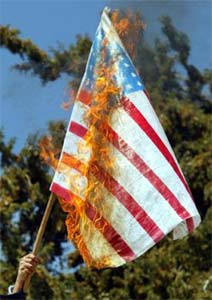
A man set fire to a U.S. flag across the street from the White House on Monday, in apparent protest of Trump's executive order.
(COMMENT, BELOW)