

 Christine Kao for The Washington Post


The Intersection of faith, culture, and politics
Tuesday
July 28th, 2026First Amendment

Published July 27, 2026
Christine Kao for The Washington Post
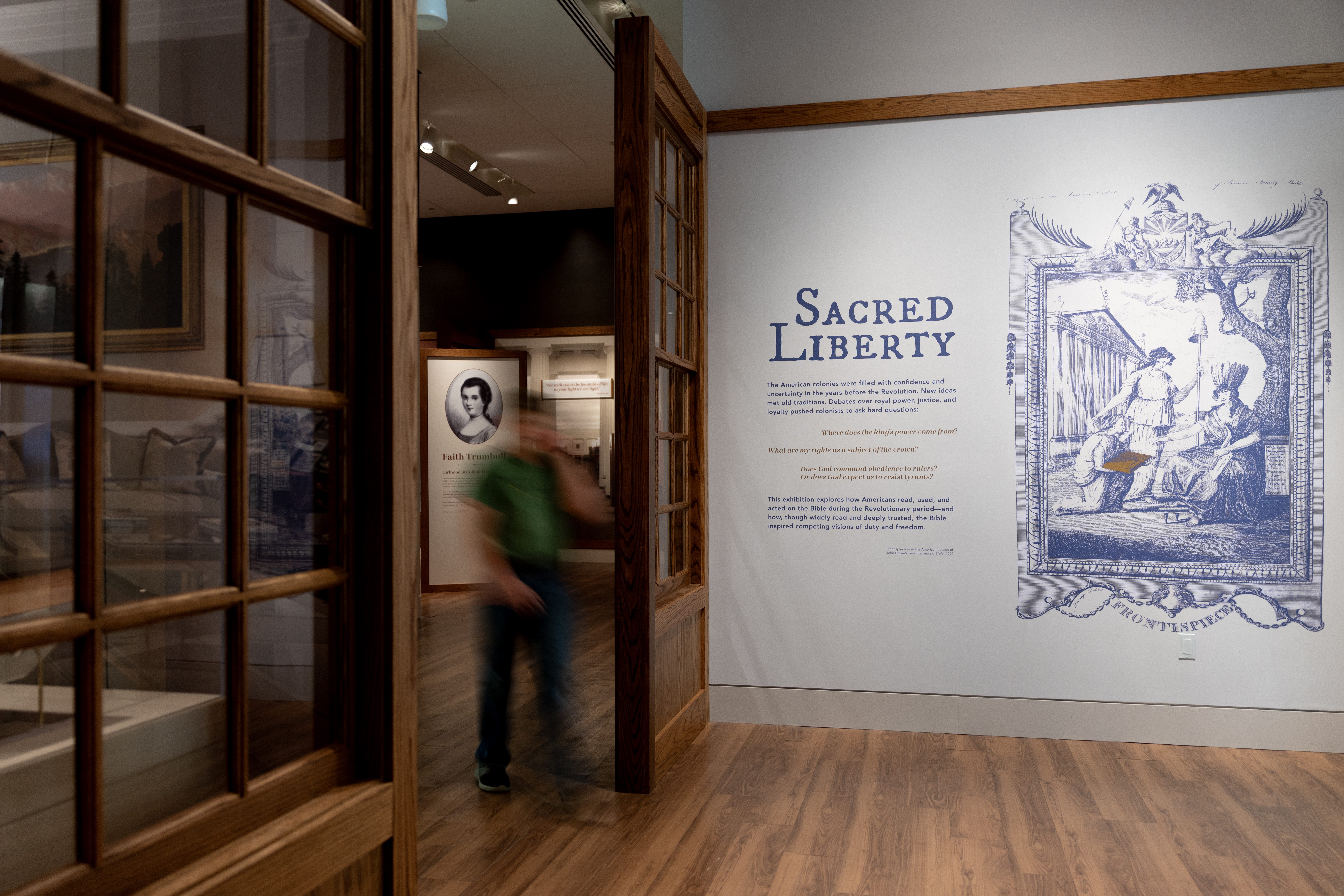
Imagine you're America's biggest Bible museum and you're crafting an exhibition for the country's 250th. Which of the 5,000 Bibles and other artifacts in your collection do you select to represent the book's impact on America's founding?
Do you focus on the ways different Christian groups used parts of the Bible to support or oppose the American Revolution? Or to support or oppose extending rights to other faith groups? Or on their discussions about government-led prayer?
For the Museum of the Bible, founded nine years ago in Washington, D.C., the goal of its centerpiece 250th exhibition, "Sacred Liberty," is similar to its overall goal as a museum: to prompt curiosity in Christian scripture, and to emphasize its prominence.
Senior curator Anthony Schmidt said the Bible was a major backdrop against which the founders debated topics such as the role of government and from where kings' rights come.
The "big documents" Americans study on July Fourth, he said, including the Constitution and the Declaration of Independence, "don't talk about faith." But to not see the impact of the Bible "is to lose an important part of history. This is the world that produced those documents."
The exhibit, which opened July 3, walks the line the museum has since its start - trying to use its vast collection and dramatic building to tell a complex story, while also keeping to the mission of its evangelical founders, and of its board, who are required to sign a statement of faith about the truth of the Bible.
Catherine Brekus, a historian of U.S. religion at Harvard, said the exhibition emphasizes evangelical perspectives of the Bible at the founding, but leaves out others. "What they're trying to say is that the Bible was key to revolutionary discourse, and they're right. But that's not the only story," Brekus said.
Mark David Hall, an expert on early America and religion at Regent University, said the exhibition is part of a needed correction to what he calls a downplaying in recent decades of the Bible's influence in America.
"The Bible was the most important text in the American founding by far and away," he said. The exhibition's theme emphasizes that "the Bible was very influential in a very positive way."
Here are a few of the items the world's largest Bible museum selected to tell the story of the founding:
Thomas Jefferson's letter
Upon retirement, Jefferson wrote to a Connecticut church on a topic he saw as one of his major legacies: religious liberty. The 1809 letter shown in the exhibit praises the Constitution for protecting "the rights of conscience against the enterprises of civil authority." Jefferson is the founding father who, in a separate 1802 letter, described the First Amendment as a "wall of separation between church and state."
The exhibition comes as the Supreme Court has in recent decades challenged and weakened that wall. The court has widened the use of tax dollars for religion and the ability of government officials to publicly pray.
Jacob Duché's sermon
Duché was known as chaplain to the first Continental Congress, where in 1774 he delivered a stirring sermon asking G od's protection for those "who have fled to Thee from the rod of the oppressor." The exhibition displays a similar 1775 sermon he preached after the battles of Lexington and Concord.
Duché's story is complex; he later recanted his support for the revolution. "Did G od change his mind [about the revolution] because Duché changed his?" asked Warren Throckmorton, author of several books about Christianity at the founding.
Judah Monis's textbook
Written by Monis, the first Hebrew textbook printed in America is one of several items in the exhibit illuminating early Jewish life. A Jewish prayer book and a marriage contract (Kesuba are also included. Schmidt says the items show the ways this then-tiny community participated in early America, "laying the groundwork" for growth and integration later on.
Yet, the exhibit doesn't name the discrimination at the time. That includes laws that barred Jews from public office and restricted their worship. The exhibit notes that Monis was the "first Jew to receive a college degree in the colonies," in 1720, from Harvard. Monis had to convert to Christianity to receive that degree and to later teach there.
The Aitken Bible
The exhibit describes Aitken as "printer to the [first] Continental Congress" and says his Bible - the first Bible printed in North America in English - "was known by many as the ‘Bible of the Revolution.'"
Indeed Congress praised Aitken, but some experts say the story of this Bible is more about the fits and starts among the founders over religion's place in the new country. Congress declined to pay for the book's printing and rebuffed Protestant clergy who had requested it print or import more.
(COMMENT, BELOW)
Every weekday JewishWorldReview.com publishes what many in the media and Washington consider "must-reading". Sign up for the daily JWR update. It's free. Just click here.
© 2026 Distributed by The Washington Post News Service & Syndicate.
 Contact The Editor
 Articles By This Author