



Insight
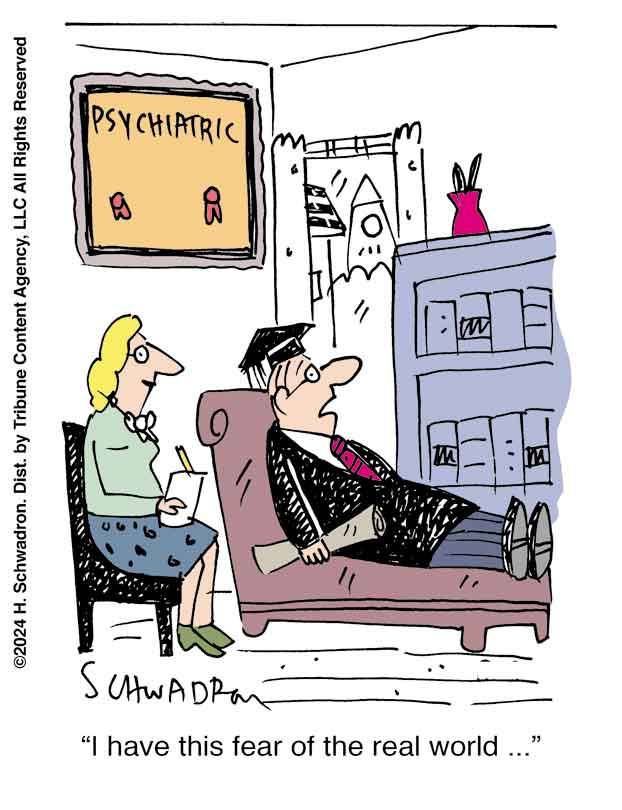
College graduates are down but not out in the job market

By Justin Fox Bloomberg View
Published Jan. 5, 2026
 Contact The Editor
 Articles By This Author
There has been a lot of talk over this same period about generative artificial intelligence's potential to wipe out tens of millions of white-collar jobs. A study last year by Stanford University economists Erik Brynjolfsson, Bharat Chandar and Ruyu Chen with the attention-getting title "Canaries in the Coal Mine?" found that employment for early career workers began falling in the most AI-sensitive occupations, most of which are heavy on holders of college degrees, around the time of the initial release of ChatGPT in November 2022. These findings inspired some pushback, but it was mainly along the lines that employment in those occupations, and among college graduates in general, was already under pressure before November 2022. Again, that's not exactly reassuring for college graduates, especially younger ones.
Forecasting AI's effect on employment at this point is still akin to throwing darts blindfolded, but it may be informative to review (1) the very latest evidence on what's going on with younger workers, college-educated workers and younger college-educated workers and (2) the longer-term story on employment and wages for college graduates. The big thing to know about the job trends over the past few months is that they're mixed - which is better than uniformly negative, as they seemed to be last fall. Viewed over years rather than months, it appears that college graduates' labor market edge stopped growing quite a while ago but is still historically large in terms of wages.
One of the more striking pieces of news in January's jobs report was that the seasonally adjusted unemployment rate for Americans 20 to 24 fell to 7.1% after hitting 9.1% in September and is now much lower than a year ago. Then again, the 4.8% rate for those 25 to 34 was the same as in September and much higher than a year ago. Both data series are pretty noisy, and developments over the past few months may end up signifying not much at all. But confusing news is better than bad news.
The Federal Reserve Bank of New York calculates statistics on unemployment among college graduates 22 to 27 and young workers overall from individual responses (aka microdata) to the household survey underlying the monthly jobs report. January's microdata aren't out yet, but the numbers through December show unemployment rising in recent months for young workers while fluctuating in an indeterminate direction for those with college degrees - which is an apparent change from the trend since 2022 of unemployment rising faster for those with college degrees than those without.
Meanwhile, the other survey used in the monthly jobs report - of employers rather than households - is showing modest hints of better times in two presumably AI-sensitive sectors that employ lots of recent graduates. Payroll employment is flat since October in computer systems design and related services after three years of declines, and rising in management, scientific and technical consulting services after two no-growth years.
The hiring boom apparent in the charts from 2020 to 2022 is important context here. Something similar transpired at large tech companies, with the number of worldwide employees rising 53% from 2019 to 2022 at Microsoft Corp., 60% at Google parent Alphabet Inc., 93% at Amazon.com Inc., 94% at Facebook parent Meta Platforms Inc. and 110% at Salesforce Inc. The weak hiring environment for college graduates after 2022 might be mostly payback for the spectacular hiring boom that preceded it rather than a harbinger.
The longer view on college degrees and employment is a little clearer - their relative value seems to have declined a bit. The gap between the unemployment rates for college graduates and those for all workers is much smaller now than it was in the 1990s through mid-2010s, and the relative position of recent college graduates has deteriorated even more.
Most of the economics literature on the labor market advantages of a college degree has focused on wages, not unemployment rates. And while the wage gap between college and high school grads has declined a bit in recent decades, as shown in this chart based on household survey microdata back to 1961 from a recent Federal Reserve Bank of San Francisco working paper, it remains extremely large relative to any time before the late 1990s.
The measure here is what workers with only four-year college degrees earn relative to those with only high school degrees. Workers with master's degrees had median weekly earnings 98% higher than those with just high school degrees, according to 2024 data from the Bureau of Labor Statistics, those with doctorates earned 145% more and those with professional degrees (law, medicine, MBAs, etc.) 154% more. Beware people who say a college degree has no value. Some degrees have little economic value, and even more aren't worth the cost, but on average those with bachelor's degrees or higher still make much, much more money than those without.
Explaining the rise, fall and rise of the college wage premium has been a significant theme in labor economics for half a century. In the 1970s, Harvard University economist Richard Freeman looked at the falling premium and concluded that too many people were getting college degrees - the 1976 book summing up his findings was titled The Overeducated American.
In the early 1980s, though, the premium started growing rapidly, which a classic 1992 paper by Harvard's Lawrence Katz and the University of Chicago's Kevin M. Murphy attributed to, well, supply and demand. That is, a phenomenon they dubbed "skill-biased technological change" (the phrase appears to have been introduced in a 1991 paper co-authored by Katz) had led to an increasing demand for workers with college degrees throughout the 1960s, 1970s and 1980s.
Big swings in the relative supply of college graduates, which began dwindling in the 1980s as the youngest of the baby boomers finished college, explained the ups and downs in the wage premium.
In their 2010 book The Race Between Education and Technology, Harvard economist and 2023 economics Nobel winner Claudia Goldin and Katz (who is her husband) extended the analysis to the entire 20th century and found a similar story, with technological change increasing demand for skilled labor all along but the rise of universal high school education and then increased access to college education tamping down wage inequality until the 1980s.
The relative supply of college graduates increased modestly after 2000 as enrollment rates continued to rise and members of the large millennial generation began earning their degrees, but over the past decade the percentage of high school graduates enrolling in college has actually declined slightly.
In the San Francisco Fed paper that I got the chart from, economists Leila Bengali, Robert G. Valletta and Cindy Zhao attribute the post-2000 stagnation in the wage premium mainly to a slowdown in skill-biased technological change and greater "substitutability" between high school and college graduates. Knowing how to use a computer used to confer a big labor market advantage. Now we all carry computers in our pockets.
Other analyses have emphasized growing wage inequality among college graduates since 2000. A somewhat depressing 2025 working paper by Princeton University's Zachary Bleemer and Vanderbilt's Sarah Quincy found that the college wage premium has fallen for students from low-income families while rising for those from high-income families.
Bleemer and Quincy attributed the falling wage premium for low-income students to (1) declining resources and instructional quality at the teaching-oriented public colleges where many congregate and (2) increasing numbers going to community and for-profit colleges. Meanwhile, the wage premiums for students from high-income families increased mainly because they had shifted since 2000 from humanities majors to computer science.
That last observation now seems a bit ironic. Times have been relatively tough since 2022 for those with new computer science degrees, and the one field that AI appears certain to transform is software development. In the New York Fed's analysis of 2024 labor market outcomes for recent college graduates by major (they haven't released a 2025 update yet), computer engineering had the second-highest unemployment rate (behind anthropology) and computer science the fourth highest (behind fine arts).
Those unemployment rates do come with pretty big margins of error, and the underemployment rates (the percentage of graduates working in jobs that don't require a college degree) remain much lower and earnings much higher for most tech- and science-oriented degrees. In economic terms, a computer engineering degree is still worth a lot more than an anthropology degree, and the $45,000 median wage for recent anthropology graduates in 2024 was still higher than the $41,056 for those with just high school diplomas.
Maybe we really are headed into a future in which technological change reduces the demand for skilled labor rather than increasing it. But the job market hasn't been turned upside down just yet.
- - -
(1) Bloomberg News reported in November that those with college degrees "now comprise a record 25% of total unemployment," which was correct - and in January this measure hit 27% - but involved dividing unemployed workers 25 or older with four-year college degrees by all unemployed workers 16 and older. (In its monthly jobs numbers the Bureau of Labor Statistics only reports data by educational attainment for those 25 and older, while the headline employment and unemployment numbers are for those 16 and older.)
Justin Fox is a columnist writing about business. Prior to joining Bloomberg View, he was the editorial director of the Harvard Business Review. He is the author of "The Myth of the Rational Market."
(COMMENT, BELOW)
Previously:
• The US-born employment and population boom that wasn't
• 09/05/25: Will AI make lawyers richer or put them out of work?
• 04/09/25: If cameras don't slow serial speeders, 'limiters' can
• 03/16/22: If cameras don't slow serial speeders, 'limiters' can
• 11/22/21: Grown kids still stuck at home? Change is on the horizon
• 10/28/21: Fewer people going to college is good news
• 07/06/20: GET READY: This new coronavirus wave isn't like the old wave
• 01/16/20: Understanding the 'war on men' in the workplace
• 01/09/18: Why some cities get all the good jobs
• 01/04/18: If you want to 'change the world,' keep it to yourself
• 01/04/18: If you want to know the future, ask the humorists
• 12/04/15: What good retirement plans everywhere have in common
• 11/27/15: Sorry, you lost the right to have your day in court
• 07/01/15: Uber Is Lobbying for All of Us