
Jeff Jacoby



http://www.jewishworldreview.com -- BRADLEY SMITH, a law professor at Capital University in Ohio, believes that political candidates should not be forced to engage in constant money-grubbing. He believes elections should not be rigged to make incumbents all but invulnerable to challenge. He believes that most members of Congress do not auction their vote to the highest bidder. Oh, and he believes the Federal Election Campaign Act could use an overhaul.
Nothing especially outré there. Yet because of his views, Smith has been labeled "a nihilist" (By US Senator Dick Durbin), a "flat-earth society poobah" (in the Atlanta Constitution), a throwback "to the dark days of Watergate" (by Scott Harshbarger, the president of Common Cause), and the equivalent of David Duke, the Unabomber, and Slobodan Milosevic (by the Syracuse Post-Standard). He has also been likened to pornographer Larry Flynt (in the St. Petersburg Times), to Dracula (by pundit Mark Shields), and to a police chief who favors criminals (by Joshua Rosenkranz, president of the Brennan Center at New York University).
What has triggered this invective is the nomination of Smith, a scholar of election law, to serve a six-year term on the Federal Election Commission. The FEC is made up of six commissioners, three chosen by the Republicans, three by the Democrats. (All are formally appointed by the president and confirmed by the Senate.) Several of the current commissioners share Smith's belief that federal election law needs to be changed. Unlike him, they want the government to regulate campaign practices more strictly. Smith believes the government should lighten up. For preaching such heresy, he is being flayed by the forces of "reform."
The national media gushed over John McCain's presidential campaign because they loved his strident calls to crack down on political contributions and negative advertising. (They are gushing still, by the way. The other night on CBS, Dan Rather closed a fawning interview with the Arizona senator by mentioning "McCain's way of thinking about reducing the corruptive influence of money in presidential politics." Over on PBS, Newsweek's assistant managing editor openly yearned for McCain to run as an independent, with Colin Powell as a running mate.) Not surprisingly, they are rather less adoring of Smith.
Before he was even nominated, The New York Times berated the GOP for "considering an Ohio law professor" who criticizes existing law "instead of scouring the country for a distinguished individual with a passion for reform." The Washington Post termed his writings "quite radical" and warned that picking him "would betray every pious utterance the president has ever made about campaign reform."
What Smith's writings reveal, though, is a man deeply concerned with making democracy stronger.
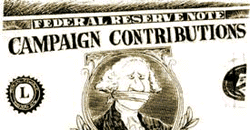
In a nutshell, he argues that the contribution limits imposed after Watergate have made politics worse, not better. By strictly controlling the amount of money supporters could give to candidates, Congress thought it would reduce the cost of campaigning, diminish the power of special interests, and make the whole system more open and competitive. It failed on all counts. Campaigns for Congress cost more than ever, influential elites -- media bigshots, unions, pressure groups -- have grown in clout, and federal incumbents are now virtually challenge-proof.
 |
Before 1974, candidates could raise most of the funds they needed from a small cadre of wealthy supporters; that freed them to talk about real issues with real voters. Since 1974, on the other hand, candidates have been forced to spend a larger portion of each waking day chasing $1,000 checks. With inflation -- 1,000 1974 dollars are worth only $290 today -- the problem has grown more acute.
Today it is hard to run for Congress and impossible to run for the White House without having either a pre-existing network of donors or an immense personal fortune. That has tilted the playing field in favor of insiders and multimillionaires. It helps explain why this year's presidential nominees will be the sitting vice president and the son of a former president -- each of whom benefited from a vast Rolodex of fundraising contacts. It also explains why the re-election rate in Congress routinely tops 95 percent.
It isn't evident, says Smith, that money corrupts candidates. Three other factors are much better predictors of how a legislator will vote: party affiliation, political ideology, and the views of constituents. "Where contributions and voting patterns intersect," he has written, "they do so largely because donors contribute to those candidates who are believed to favor their positions, not the other way around."
What is evident is that campaign finance caps stack the deck in favor of incumbents. "Incumbents begin races with high name and issue recognition, so added spending doesn't help them much," Smith writes. "Challengers, however, need to build that recognition." That takes money -- often a lot of it.
In the end, of course, Smith's analysis of federal election law matters less than his ethics and experience. Everyone who knows him attests to his integrity, and all agree that his knowledge of election law is encyclopedic.
The job of the Federal Election Commission is to enforce existing law;
Smith
says he is willing and able to do so. That ought to settle the matter --
unless the Senate is prepared to say that the only persons qualified to
enforce a law are those who think it is perfect. Smith would make an ideal
regulator: He understands the risks of too much government. If only more
bureaucrats shared that

Jeff Jacoby is a columnist for The Boston Globe. He may be reached by clicking here.
