
Tony Snow


http://www.jewishworldreview.com -- BILL BRADLEY has become the Garbo of the Hustings -- a man of few words, but luxurious intimations; a celebrity wreathed in mystery and dark promise. While such behavior might have seemed snobbish in years past, it now seems bracing -- even reassuring.
Bradley is a prig, full of high sentence. And like most prigs, he keeps his urges in fetters. One can no more imagine him answering a question about boxers or briefs than one could envision the pope putting his imprimatur on a Marilyn Manson video.
But there is one area in which his refusal to discuss himself seems troubling and odd. That's the arena of religion. Bradley has not always held his tongue on such matters. As a college student, he told hagiographer John McPhee that his faith was his chief guide and support, and remarked with regret that his views placed him among a minority in society.
He grew up across the street from a Presbyterian church in Crystal City, Mo. His mother taught Sunday school, and his family attended services regularly. The routine become so much a part of his constitution -- and Bradley is nothing if not a man of starchy routine -- that he later joined the Fellowship of Christian Athletes and barnstormed the country, proselytizing and playing basketball.
But something happened. No doubt the growing complexities and cares of adulthood altered his views and tested his faith. In any event, he now maintains monkish silence, insisting that his convictions are keenly personal and inviolate.
Here's why he is wrong: It matters where a politician gets his morals. It matters who a politician regards as an authority. These beliefs profoundly influence the way a person exercises power.
Only two candidates so far -- Alan Keyes and George W. Bush -- have addressed the issue. Bush has hinted in speeches that he believes in natural law -- the belief that our bedrock views of right and wrong emanate not merely from custom or practice, but from God, who speaks with greater authority than, say, the Senate Judiciary Committee.
This may seem quaint, but it has distinguished lineage. Thomas Jefferson wrote in his Notes on the State of Virginia, "Can the Liberties of a nation be secure when we have removed a conviction that these liberties are the gift of God?" George Washington's farewell address includes the observation that "Reason and experience both forbid us to expect that national morality can prevail in exclusion of religious principle." And Alexander Hamilton decreed that "The sacred rights of mankind ... are written as with a sunbeam ... by the hand of Divinity itself and can never be erased or obscured by mortal power."
Our democracy becomes incoherent the moment one insists that rights derive only from legislatures and lawgivers. The ideal of "inalienable rights" vanishes entirely.
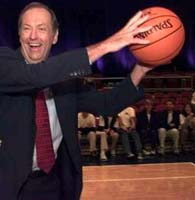 |
| Bradley |
In its place rises a theory of law that makes every man a pawn, every judge a god and every fad the foundation of a new legal theory.
Contrary to fashionable scholarly opinion, natural law doesn't countenance theocracy. Neither the founders nor Bush felt compelled to embellish their observations with theological musings. Instead, it defends individuals by placing limits on what government can do to them.
So does Bradley believe that some moral truths are self-evident? That we possess rights that the state has no authority to abridge? This is an important matter because Bill Clinton will hand his successor a good economy and a nation on the verge of moral vertigo.
As George Marlin points out in "The Politician's Guide to Assisted Suicide, Cloning and Other Current Controversies," manmade law alone cannot guide us from the brambles. Prosecutors in the Nuremberg Trials had no strictly legal basis for prosecuting Nazi atrocities because international agreements offered no controlling legal authority for genocide. Prosecutors instead relied on natural law, on a belief in unalterable and widely accepted moral absolutes.
Clinton's brash relativism has plunged us into doubt. We have accepted absurd explanations without complaint -- such as his assertion that the verb, "to be," is laced with ambiguity. He has delivered us to a wonderland where nothing matters but the escape clause. He has bequeathed a world without certainty, besotted with cleverness; a world of brutish force -- IRS audits of political foes, intimidation of alleged lovers, military strikes timed to coincide with grand-jury testimony, wars driven by polls, executive orders that serve as ukases.
Bradley doesn't need to become a Bible-thumper to answer the question of
whether he has religion. But he does have an obligation to provide evidence
that his priggishness -- the source of his perceived authenticity and
reliability -- is the real deal and not just a political head

