 |
|
|
Robert Leiter
IN A REGULAR MYSTERY story, the detective generally only has to solve the
crime --- who killed whom and why. In a Jewish mystery story, the detective
not only has to solve the crime but often has to grapple with the mystery of
being.
So argues Lawrence W. Raphael, a rabbi and the editor of a new collection of
mystery and detective tales titled Mystery Midrash, just out as a paperback
original from Jewish Lights publishers.
"So when I had the idea of putting together this collection," he explained,
"I thought of approaching only writers in the affirmed category, because I
wanted them to develop some aspect of their character's Jewishness in their
stories.
The completed 304-page anthology includes pieces by such noted Jewish
mystery writers as Faye Kellerman, Stuart M. Kaminsky and Ellen Rawlings, to
mention only a few.
According to Raphael, an extreme example of these struggles with identity
appears in the works of author Linda Barnes, whose taxicab private eye,
Carlotta Carlyle, has a Jewish mother and a Catholic father.
Raphael said he has many favorites among the pieces in Mystery Midrash, but
that one story he really admired because it touched on many substantial
themes is Batya Swift Yasgur's "Kaddish."
"There's the fact that a highly assimilated cop has to do the investigation
of the death of an Orthodox rabbi and there's also what happens when he
finds out it was actually a suicide. Even he knows it's a shanda. The story
dealt with really important themes. But I could say that about lots of the
other stories as well, I realize."
One of the things Raphael said he was proudest of in the collection was that
five women writers were represented, as he worked hard to establish that
kind of balance.
"There are lots of good Jewish mystery stories out there," the editor said.
"I'm just hoping that this book will be popular and they'll ask me to do a
volume
Why Jewish mysteries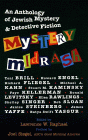
Purchasing this book
-- linked below --
helps fund JWR
are different
 In fact, Raphael, a longtime student of the genre, has divided Jewish
mysteries into three categories based on matters of identity: assimilated,
where the character cares little about his or her Jewish identity and may be
intermarried; acculturated, where some part of the character's or the plot's
development is related to a sense of Jewishness; and affirmed, where the
character is clearly identified as a Jew and Jewish religious traditions
advance the plot.
In fact, Raphael, a longtime student of the genre, has divided Jewish
mysteries into three categories based on matters of identity: assimilated,
where the character cares little about his or her Jewish identity and may be
intermarried; acculturated, where some part of the character's or the plot's
development is related to a sense of Jewishness; and affirmed, where the
character is clearly identified as a Jew and Jewish religious traditions
advance the plot.
 "When I asked her why she created the character as she did, she said she
wanted to give her as much guilt as possible," Raphael said. "People should
also understand that many of these writers are themselves struggling with
the issues of identity that appear in their works."
"When I asked her why she created the character as she did, she said she
wanted to give her as much guilt as possible," Raphael said. "People should
also understand that many of these writers are themselves struggling with
the issues of identity that appear in their works."
JWR contributor Robert Leiter is Literary Editor of the Philadelphia Jewish Exponent.

