 |
|
|
Judy Gruen
EIGHTEEN YEARS AGO, while a journalism intern at the Jewish Student Press Service in New
York, I went to hear Rebbetzin Esther Jungreis, founder of the outreach organization Hineni. I
had heard that Jungreis was a powerful speaker. So I came, but with an agenda.
At that time, I was not a ritually observant Jew. I loved covering Jewish stories and issues,
but my interest was more political and cultural rather than religious. That night, I heard but
did not really listen to Rebbetzin Jungreis. I found her presentation overly dramatic, her
manner affected. She did not touch me.
Astonishingly, the event was sold out. Since then, Jungreis has brought her message of faith in
G-d and Jewish tradition to people around the world.
Each week between fifteen hundred and two thousand people in Manhattan come to hear her class
on the Torah portion. She also has a weekly Torah class broadcast on the Jewish Television
Network. The executive director of Hineni boasted to me over the phone that this organization was
the very first to do widespread kiruv, or Jewish outreach, far predating other organizations
known for it, such as Aish HaTorah.
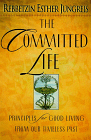
But very recently, I picked up her new book, The Committed Life: Principles for Good Living from Our Timeless Past. Skipping through its pages, I was intrigued. Jungreis’ writing was
crisp, articulate, and moving.
I bought a copy for my sister-in-law, but she ended up having trouble getting it from me, since
once I began reading it, I didn’t want to give it up. “The Committed Life,” now in its seventh
printing, relates the Rebbetzin’s most memorable experiences of a lifetime. She writes of being
a young girl in Bergen-Belsen, where her father reminded her to always keep a smile on her face
to give others hope. She recalls her life as a new immigrant in the U.S., where her father’s
passion and optimism made him work immediately to build a yeshiva, bringing Torah knowledge where
it had faded away. She writes as a mother anguishing over a daughter’s diagnosis with a
potentially life-threatening disease, and as a wife coping with the enormity of losing her
beloved husband at Sloan-Kettering Hospital.
Having read much of the book when my own mother-in-law lay comatose in the hospital, Jungreis’s
stories on faith, commitment, responsibility, forgiveness, family life, hope, and so much more,
gave me strength. So when I saw that she was coming to town to speak, I decided that after
eighteen years, I was ready to listen.
Speaking recently at Sephardic Temple in West Los Angeles, Jungreis hammered the topic of
personal responsibility, using examples from the Torah. “Our mothers Rachel and Leah were the
greatest women who ever walked the earth,” Jungreis stated, but emphasized that their father
Her message to “take charge of your life” resonated among the crowd, and her heart-rending tales
of life and hope amid the utter barbarity of the Nazi concentration camps brought tears to many
in the audience. “It’s not the situation, but how you handle it,” Jungreis said. And she
encouraged people to listen to their brothers and sisters and to hear their pain, just as we
would want G-d to listen to ours.
Nearly twenty years after first hearing Esther Jungreis, I was grateful to have attained my own
passion for Jewish tradition and belief in G-d. Now, instead of seeing her as a campy,
theatrical performer, I was able to see her for what she really is: On fire with the spirit of
G-d and with an incredible passion to bring fellow Jews closer to their
Esther Jungreis: Spreading the Word about “The Committed Life”

 Over the years, Jungreis’ fame swelled, and thousands count themselves as her students. Jungreis
launched the Hineni Heritage Center in 1972 after she and a friend daringly booked Madison Square
Garden for one of her
presentations.
Over the years, Jungreis’ fame swelled, and thousands count themselves as her students. Jungreis
launched the Hineni Heritage Center in 1972 after she and a friend daringly booked Madison Square
Garden for one of her
presentations.
 Fortunately for me, I did eventually overcome my own myriad misconceptions about traditional
Judaism, and found my way to Jewish observance, though without the Rebbetzin’s help. Even after I
became committed to Torah observance, though, I never bothered to listen to Rebbetzin Jungreis
when she came to town.
Fortunately for me, I did eventually overcome my own myriad misconceptions about traditional
Judaism, and found my way to Jewish observance, though without the Rebbetzin’s help. Even after I
became committed to Torah observance, though, I never bothered to listen to Rebbetzin Jungreis
when she came to town.
The rebbetizin has lost none of her fire. Hollywood
thin and dressed glamorously in all black, she is still diminutive even in three-inch heels. Her
presentation is still very theatrical, and some might find it distracting. But she commands the
room as soon as she enters it. Beginning in a tone barely above a whisper, she is judicious about
raising her voice, tinged by a curious Hungarian-New York accent. One male friend was struck by
Jungreis’ sometimes seductive body language and clinging skirt, remarkable for someone so frum
and “of a certain age.” But clearly, Esther Jungreis was born to perform, and for the past
several decades, she has used this gift to bring Jews closer to their faith.
Purchasing this book
-- linked above --
helps fund JWR Laban was a consummate liar and thief. “Our matriarchs never complained that they came from a
‘dysfunctional family,’” she noted tartly.
Laban was a consummate liar and thief. “Our matriarchs never complained that they came from a
‘dysfunctional family,’” she noted tartly.

JWR contributor Judy R. Gruen’s articles have appeared in the Los Angeles Times, Chicago Tribune, the Jewish Journal and many other publications. Contact the author by clicking here.

