 |
|
|
Jewish World Review July 6, 2000/ 3 Tamuz, 5760
Elliot B. Gertel
These days, the practice is becoming more and more common.
It goes without saying, before making any agreement, you'd expect a congregation to insist on
certain requisite standards --- positive portrayals of Jews or, at the very least, of Judaism, and the refusal to glorify religious abandonment via intermarriage. Well, most of us would.
Recently, I contacted the executive director of a landmark Chicago Reform temple that has been used by
David E. Kelley Productions and also by "Early Edition." The latter series used the vintage sanctuary for
what appeared to be an interfaith marriage ceremony. When I inquired as to the synagogue's policies, I
was told they treat their sanctuary as a landmark backdrop with no innate sanctity. They will, therefore,
rent the space out to non-Jews for weddings with any type of ceremony and to non-Jewish institutions for
graduations with full rituals. Their outlook is that "space is not sacred
or worshipped in Judaism."
It's an interesting policy, though it is not consistent with normative Judaism.
According to Jewish Law, once a space has been
made sacred, set aside for a beis k'neses, it cannot be used for any other purposes; it is considered
improper for people even to pass through it just for a "short cut." Why promote a notion
that Judaism has no sense of sacred space? How could Jews or non-Jews take a synagogue seriously out
of such a mindset?
Still, I have to give this congregation credit for having deliberated on the issue and forged a consistent policy. This is, however, a policy that will, no doubt, one day bring them great embarrassment.
But what about the landmark New York synagogue sanctuary that was used for the movie "Keeping the faith"? Here was a film with a morally deficient theme and message that depicted rabbis as having far less religious scruples than priests, and didn't do much for priest, either, by the way.
When I contacted the famous "mega-synagogue" housed therein, the darling of pundits on "creative" planning and the model of "Synagogue 2000," the wagons were circled round about the temple office and I was told, "Neither the staff nor the officers have any comment."
It would seem that the paradigm of the "open" and "inviting" congregation wants no part of dialogue and
reflection when it comes to the most public possible decision a synagogue can make --- namely, placing its
sanctuary at the disposal of Hollywood cameras.
And speaking of Hollywood, what about the Los Angeles temple which, over a decade ago, lent its
sanctuary and religious school (and its cantor) to an independent Jewish filmmaker who concocted a short
"drama," shown on cable TV, which pointed to the "ironies" of a Jewish boy choosing to be baptized as
a Catholic right before his bar mitzvah, with the ultimate sanction of his parents and with the Church
being depicted as earnest (if cradle-robbing) and all the Jewish characters being flippant and insensitive?
Did anyone at that temple, including the cantor who participated, read the script in advance? Or is it
"inappropriate" to "artistic freedom" for someone at these congregations, preferably the rabbi, to read the
script in advance?
One has to wonder, finally, whether it would help to have the proposed scripts read by rabbis before filming. Some of these films
and TV shows actually have rabbinic consultants. Their job is to check rituals for accuracy. But nobody, it seems,
truly cares about the
06/21/00: Defunct 'Early Edition' is no loss to people of faith
Sacred synagogues? Not when Hollywood comes calling
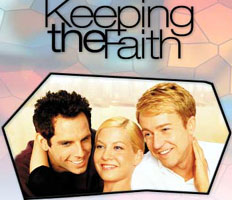
This movie, including a scene filmed
in a synagogue, was about anything but 'faith'


Contributing writer Elliot B. Gertel, JWR's resident media
maven, is a Conservative rabbi based in Chicago.

03/20/00: When Black Archie Bunkers 'diss' the 'Jewish doctors'
03/07/00: Jack and Jill: Turning the table on stereotypes?
07/27/99: Popular Providence sends troubling messages about religion and science
06/14/99: May 'The Nanny,' R.I.P. --- not!
06/07/99: Suddenly Susan's Death of a Rabbi
05/13/99: During the "sweeps," religion suffers
