 |
|
|
Jewish World Review Oct. 11, 2000 / 12 Tishrei, 5761
http://www.jewishworldreview.com --
WOULDN'T IT be better if
we were all self-sufficient?
Clearly, G-d could easily
have endowed each of
His creations with the full
measure of intellect,
strength, health, ability
...everything from a way
with words to an unfailing
sense of direction.
However, as is obvious,
He didn't. Not only do
we perceive instantly
that He did not
build us “fully
loaded,” but we
even thank Him for
our deficiencies,
each and everytime
we finish
eating certain
foods.
The concluding
blessing
“Borei nafoshos
rabos,” has within
it this
seemingly
unusual
concept.
“Blessed are You Hashem,
our G-d, King of the uni-verse,
Who creates numer-ous
living things with their
deficiencies... .”
To understand why we
thank G-d for a poor
command of math, a bad
sense of direction,
hayfever, forgetfulness
and millions —
possibly
billions — of other
human flaws,
consider the
world without
these deficiencies.
Each person
would be
a self-contained
island,
with no real
need to connect
with others.
Nobody would be motivated
to reach out to anyone else,
and nobody would have
anything significant to
offer.
The late sage, the Chofetz Chaim, ZT"L, sees
in this blessing evidence
that G-d built the world
upon the quality of chessed,
kindness. Kindness is activated
by the needs of others.
Our strengths fill in other
people's gaps, and the
strengths of others supply
what we're lacking. The
doctor needs the grocer; the
grocer needs the farmer,
who in turn needs the doctor.
The end of our blessing is "l'hachayois bo'hem nefesh kol choi," "to give life through them to all living things." It is these very creatures, complete with their deficiencies, that creat chessed --- the foundation of life in this world.
Better Relationships
THE GREATEST
In our culture of self-promotion,
few qualities sound
as quaint as “humility.” But it
was just this quality that the sage,
Ramban, in his letter
(Iggeres Haramban) to his
son, stressed as the “finest of
all admirable traits” and the
key to serving G-d.
To
acquire this trait, “Let all
men seem greater to you in
your eyes,” he advised.
Rav Yosef Weiss of
Lakewood, New Jersey, once asked Rav
Yehudah Zev Segal, zt'l., the
Manchester Rosh Yeshiva,
how it is possible to follow
this directive. One need only
look around at the population
of the world to realize
the difficulty in feeling inferior
to everyone. The answer,
said Rav Segal, is to understand
that every person is
superior in some way. Even
the “lowest of the low” has
some quality in which he
surpasses you. Even the
career criminal has some
trait — perhaps it's die-hard
loyalty to his gang, or
courage in the face of danger
— that others could benefit
from emulating.
By recognizing that everyone
is our superior in some
way, we can nurture the quality
of humility within ourselves.
Inner Excellence
AS IF
“I'm just not a 'kid' person. I
don't have the patience,” the
man explained. It was his rationale
for his
tense relationship
with his
children. “I'm
not outgoing,”
said the woman.
This bit of self-analysis
was her
justification for
pretending not
to see most
neighbors she
encountered on
the street.
A l t h o u g h
G-d made
many different
types of people,
each with a
unique set of strengths and
weaknesses, He made only one
Torah (Bible) that binds us all. The self-centered
person isn't exempt
from the need to show kindness.
The stingy person isn't
exempt from giving charity.
The reserved person doesn't
have special license to ignore
others, nor the impatient
person to snap at
those who irritate
him.
“Going against
the grain” seems
impossible, but
the Torah teaches
that it is not.
Rabbi Moshe Chaim
Luzzato, in his
famous ethical
work “Path of the
Just,” advises those
who are reluctant
to perform an act
of kindness to just
pretend. Act as if
you're enthusiastic,
he says, and
you will find your inner self
responding likewise.
The same strategy is true
when any character trait called
for in a certain situation is in
short supply within you. Act
confident, and you give yourself confidence.
Act compassionate,
and you find yourself
slipping into the role you've
created. Using the "as if"
approach opens a person up to
experiences beyond the boundaries
of his nature. And these
experiences, ultimately, remold
that nature. By acting "as if,"
you can create a new grain, a
new self, capable of grasping
every opportunity for growth
with enthusiasm and joy.
Adapted from "Begin Again Now," by Rabbi Zelig Pliskin, with permission
of the author
Life's Lessons
SMALL MATTERS
One afternoon as the sun was
setting over Jerusalem, two distinguished
residents of the city
were out walking. In the distance,
they observed a man leaning on a
lamppost with both hands.
Concerned that he was ill, they
rushed toward him. Only then did
they recognize him as the
renowned scholar, Rabbi Shlomo
Zalman Auerbach, zt”l, who was
in the process of hanging a notice
on the lamppost.
“Maybe you didn't hear the tragic
news,” he explained to them. “But
Reb Boruch Rothschild, who lived
here a number of years ago,
passed away today.” With the funeral
imminent (burials take place
even at night in Jerusalem), Rav
Shlomo Zalman, one of his generation's
great leaders, took it upon
himself to go about the neighborhood
posting notices, lest the news
remain unpublicized.
While many people consider
themselves too busy to take care
of small matters, to the truly
great, nothing is insignificant.
Adapted from “Along Maggid's
Journey,” by Rabbi Paysach J. Krohn,
with permission from Mesorah
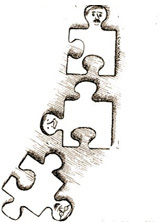
The value of being deficient


Chosen Words, a newsletter of spiritual and personal growth, is produced by the Chofetz Chaim Heritage Foundation. Comment by clicking here.

