
|
|
|
Rabbi Avi Shafran
Twin teachings
http://www.jewishworldreview.com |
Distance in time, no less than in space, provides perspective. And so the
passage of a year since the Islamist terror attacks on our country should
spur us to try to mine insights from the disaster. To my mind, two lessons
from that bright and sunny turned dark and hellish day stand out. Neither
is particularly astonishing or novel, but each is worth a quiet moment of
contemplation..
The first is that evil exists.
That's not as self-evident an assertion as it might first seem. All too
many people, after all, choose to view words like "right" and "wrong," and
certainly "good" and "evil," as possessing no absolute meanings, and see in
history only competing desires, not ultimate ideals. In fact, moral
relativism, if it even suffered a blow in the attacks, has enjoyed quite a
comeback in the months since, in particular with regard to the Middle East -
with prattling pundits likening the victims of murderous violence with its
perpetrators and offering amoral aphorisms like "one man's terrorist is
another man's freedom fighter."
It is, however, the diametric approach to life and history that we should
glean from the wanton destruction of last September 11: That what we humans
do makes a difference, that we are here for a higher purpose - not to
acquire a bevy of celestial mistresses but rather to live lives of service
to others and to our Creator. That our individual lives and history itself
are combat zones for battles between good and evil. That the bloodthirsty
are the opposite, not the equals, of the reluctant warriors. And that last
autumn's attacks revealed an example of the deepest evil of all, the kind
that believes itself to be good.
My second suggestion for contemplation is not unrelated to the first, but
touches a more sensitive spot.
The Talmud teaches that when one experiences something painful, he should
take careful stock of his life and behavior. Adversity, in other words, can
be a divine message.
That does not mean one can ever determine with certainty the cause of one's
pain. What it means is that each of us has a responsibility to try to
understand what may have left him vulnerable. A nation, presumably, must do
the same.
In the wake of last year's attacks, a prominent evangelist identified
several societal ills he maintained had weakened America's merit for Divine
protection. He was roundly excoriated, especially because his suggestions
concerned gender issues and the unborn - charged topics that generate more
heat than light when broached in the public square. But the concept of
seeking areas of moral vulnerability was - and is - not misguided.
Jewish tradition, to be sure, clearly considers homosexual activity (and
especially its legitimation) as well as most abortions to be deep moral
wrongs.
But I have another suggestion for national introspection. It is more
prosaic but more readily evoked by the imagery of September 11. And it is
more equitable in its finger-pointing; it indicts us all.
While all the September 11 attacks entailed tragic loss of life, for most
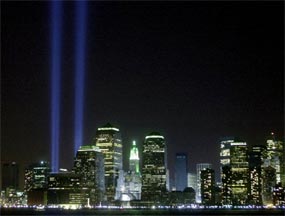
people the chief image of the destruction remains the Twin Towers.
Those soaring edifices represented achievement, commerce and material
success; they were fitting reflections of the society that bustled below
them, awash with the pursuit of worldly possessions.
All people would rather be haves than have-nots, of course; there is nothing
wrong with living comfortably. But might we Americans have allowed things
to get somewhat out of hand in recent decades? Have we not subtly morphed
from haves to must-haves? Into people who judge others by the electronic
gadgets they carry, the car they drive, the price of the watch on their
wrists?
Some thought it odd or incongruous when several renowned Orthodox rabbis
took the initiative last fall to issue guidelines limiting their followers'
expenditures for weddings. Though the guidelines were never presented as
such, they may well have comprised the most sublime and trenchant response
to the September 11 attacks. We readily recognize the need to address
air-travel procedures in order to avoid future vulnerability; addressing the
societal plague of rampant materialism might, in a deeper sense, be even
more vital.
September 11 falls this first year since the attacks smack in the middle of
the Ten Days of Repentance, the time of year Jewish tradition considers most
fortuitous for making changes for the better in our personal behavior. We
would all do well to take the opportunity to remind ourselves that material
possessions and success are not inherently meaningful, that only spiritual
wealth is true wealth - and that repentance empowers good and undermines
evil.



09/06/02: A time to cry
08/13/02: Rescued from the depths
05/31/02: Them and us
05/16/02: Shavuos: Custom-made for American Jews?
03/27/02: What's with the fours?
02/26/02: Fighting Iron with Irony
01/29/02: Confessions of a Jewish fundamentalist
10/25/01: An unabashedly biased book review
08/09/01: Getting biblical
07/11/01: History abuse
07/11/01: Reminded by science
06/18/01: Mastering McVeigh
05/02/01: Bless Peter Singer's soul
03/01/01: Poisoned pens
02/13/01: Survivors
02/02/01: Gifted
11/04/00: The shofar shoes
08/10/00: A Tisha B'Av memory
06/08/00: Question and Answer
04/18/00: The man on the bimah
04/04/00: DEFINING MORALITY DOWN
01/12/00: Friendly words from a surprising place
12/03/99: The original spin on Chanukah
11/09/99: Heart and soul
10/26/99: Recidivist parents
07/17/99: Wake Up Call?
06/14/99: A Remarkable Reform Manifesto
03/26/99: Message In A Bottle
03/09/99: The Times and The Timeless
01/20/99: Black Hats, Bad Guys
12/10/98: Bringing Wall Street
Wisdom To the Quest for 'Jewish-Continuity'
7/06/98: Jaded
7/01/98: Full disclosure