|
|
|
Jewish World Review Dec. 4, 2002 / 29 Kislev 5763
http://www.jewishworldreview.com |
Growing up, my family always lit a single menorah in an interior room
of the house. As a student in a Jerusalem seminary, I learned the menorah is supposed to be
placed near a window looking out onto the street to publicize the
holiday, and each member of the household should light his own.
I quickly grew to love this enhanced way of honoring events that
happened some 2,000 years ago.
The Chanukah story is well known. The Syrian-Greeks occupied the
land of Israel and commandeered our Holy Temple. They outlawed
many of our religious practices and defiled the Temple. Then a group
of Jews, known as the Maccabees, rebelled, driving the Syrian-Greeks
out and reclaiming the Temple. Topping off the victory, a flask of oil
meant to last just one day, miraculously burned for eight.
But the battle of Syrian-Greek versus Jew ran much deeper than a
mere physical occupation of our land. It was the battle of two great
forces - spirituality versus physicality.
Syrian-Greek culture placed beauty and intellect above spirituality
and religion. It honored and revered all that the physical world
represented. In their aspiration for aesthetic idealism, however, they
denied the transcendence of the human spirit and rejected any
notion of metaphysical reality. Thus it should not surprise us that
they fought so desperately to uproot Torah, the spiritual compass
for morality and spirituality.
Judaism teaches that the potential for human greatness is achieved
not through the ascendancy of the physical, but by subjugation of
the physical to the spiritual. We strive to break through the bounds
of physical limitation and aspire for a higher reality, one that lies
beyond materialism, beyond superficiality.
The Syrian-Greeks enjoyed a high measure of success in
"converting" Jews who succumbed to the attractions of secular life.
These Jews, known as Hellenists, thrived in the cultural ambivalence
offered by the Syrian-Greeks to such an extent, that Jewish
tradition was on the verge of disintegration.
The Jewish people had survived attempts by the Babylonians and
the Persians to destroy them physically and spiritually, but never
before had a movement from within sought to redefine the beliefs
and practices that had shaped the Jewish national character since
the time of Abraham.
Ultimately, the Macabbees routed the enemy, the Temple was
rededicated, the oil miraculously burned for eight days and the
Hellenists were discredited. And just who were these victorious
Macabbees? None other than the Cohanim, or the priests, of the
nation.
On Chanukah, therefore, we celebrate the victory of traditional
Jewish culture over both the external forces that strove to overturn
it, and the forces within that wished to dilute it.
Today we find ourselves in much the same shoes, but in an even
more complicated mixture. Ideological sects lay claim to spiritual
authenticity, separatist movements labor to set themselves apart
and multiculturists demand a coming together. Terrorism, ethnic
cleansing and hate crimes prod us to wonder if we may not be
better off abandoning our culture and religion.
Had the ancient Syrian-Greeks not sensed their beliefs were
threatened by Jewish monotheism, they would not have fought so
desperately to crush Judaism. Had the Hellenist Jews felt more
secure in the traditions of their ancestors, they would never have
contemplated compromising their heritage by pursuing secular
culture with such fervor.
The one who knows what he believes and why is both immune to
the attraction of foreign culture and tolerant of sincere alien belief.
He will be neither bullied nor seduced by the philosophies of others,
because he is secure in his own. He will be able to live in harmony
with others and work together for the common welfare without
sacrificing his ideals or compromising his values.
For more than 2,000 years, the lights of Chanukah have burned as a
symbol of spiritual wisdom. And it is the menorah that represents the
way the soul finds its expression in this world. No matter how much
darkness surrounds us, we still light the menorah, because we know
who we are and who we can be.
This year, proudly place your menorah in a spot where the outside
world can gaze in and see your spiritual light illuminate the darkness.
Enjoy this writer's work? Why not sign-up for the daily JWR update. It's free. Just click here.
JWR contributor Marisa N. Pickar is a Laguna Woods, Ca.-based journalist. Comment by clicking here.
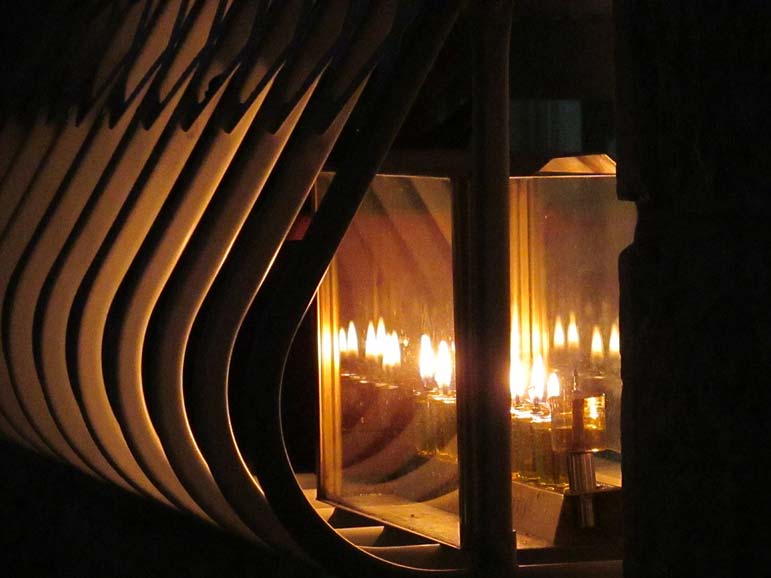 Let the light of spiritual wisdom shine
By Marisa N. Pickar