
|
|
|
Try as they might, religious leaders will never convince the child in each of us that Chanukah is a minor holiday
http://www.jewishworldreview.com --
DESPITE what rabbis and religious educators
have proclaimed, I will never view Chanukah as a minor holiday.
It's too much fun.
Sure, Passover has Elijah coming through the
door and magically imbibing the glass of wine. Purim has costumes
and a perhaps reluctant heroine. Sukkos offers nights under the
stars in a lean-to of sorts. And, of course, Rosh Hashanah and
Yom Kippur offer satisfying times of meditation and recommitment to values.
But the inner-child in me still believes Chanukah is the most fun. Scholars
may argue that were Chanukah without presents to compete with Christmas,
it would pass almost unnoticed. I don't believe it. The joys of Chanukah stem
from far more than the gifts.
For those who require a more high-brow explanation, turn to Bruno
Bettelheim, the revered child psychiatrist best known for his now-dismissed
theories about autism. Bettelheim wrote a seminal work on the purposes
served by fairy tales in The Uses of Enchantment, published in 1975. He
contended that fairy tales hold universal appeal for children because they do
not shy away from the dark side of life.
"Psychoanalysis," he wrote, "was created to
enable man to accept the problematic nature of
life without being defeated by it, or giving in to
escapism. Freud's prescription is that only by
struggling courageously against what seem like
overwhelming odds can man succeed in wringing
meaning out of his existence.
"This is exactly the
message that fairy tales get across to the child in
manifold form: that a struggle against severe
difficulties in life is unavoidable, is an intrinsic part
of human existence -- but that if one does not
shy away, but steadfastly meets unexpected and
often unjust hardships, one masters all obstacles
and at the end emerges victorious."
Though hardly a fairy tale, the story of Judah Maccabee and his family fulfills the same requirements. In
addition, the episode speaks to one of childhood's most troublesome feelings:
that of the powerlessness of the small in the face of the mighty. When my
children were young, I visited their mostly non-Jewish classes to tell the
story of the Maccabees. I brought props -- swords and shields, oil and
helmets. In my retelling, I asked the children to imagine they had no
weapons, no money, no uniforms, only the conviction and commitment that
their cause was just. I described them outwitting their enemies, using their
knowledge of the terrain to hide and then ambush the well-heeled
opponents. There was never a child who did not relish the thought of the
weak vanquishing the strong. One needn't be Freud to understand why. Add
to that the miracle of a small amount of oil -- found by a child -- lasting
eight days, and you have all the elements of enchantment.
Most kids probably can't explain why the story of Judah and the Maccabees
holds such appeal. My sons would instead talk about the chocolate
Chanukah gelt we keep finding around the house for months, the cake we
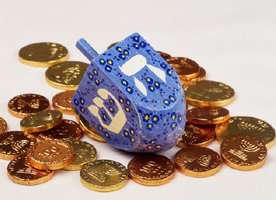
bake in the shape of a dreidel, the "hot" gambling games on our living room
floor, the story books about the flying latke and the grandma who fed the
bear instead of the rabbi, our family tradition of retrieving one's gifts from
the top of the stairs (created because I never wrap anything until the last
minute), the multiple menorahs (including a tacky electric plastic one) we
light to magically illuminate the winter darkness, and the hundreds of potato
pancakes and quarts of applesauce ingested over eight days.
Learned adults can keep saying that Chanukah is a minor holiday, but they'll
gain little following. That tack is rather like trying to convince a youngster to
watch a documentary on Renaissance art instead of the Harry Potter movie.
The truth is, children -- and the child in all of us -- will always wait
expectantly for the lights to be lit, the dreidels to be spun, the pancakes to
crackle in the pan, and the story to be retold about how an ordinary guy, in
extraordinary circumstances, would become a
Jewish World Review Dec. 17, 2001 / 2 Teves, 5762
There's nothing minor about Chanukah
By Judith Klein


JWR contributor Judith Klein is the editor of the Jewish Journal North of Boston. Comment by clicking here.
