
|

|
|
|
|
Jewish World Review Oct. 16, 2001 / 29 Tishrei, 5762
LONDON DIARIST
While he has indeed missed opportunities, Arafat has
also demonstrated a rare genius for survival: He has
walked away from assassination attempts, a hideous
car crash on the Amman-Damascus road, the civil
war in Lebanon (despite Israeli and Syrian attempts
to kill him), and a decade later, in 1992, he walked
away from a plane crash in the Libyan desert.
Then, in December 1990, he appeared to write his
own political death warrant when he embraced
Saddam Hussein following the Iraqi invasion of
Kuwait, angering not only in Washington but also
his oil-rich backers in the Gulf. Less than three
years later, he was being feted at the White
House after signing the Oslo Accord with the
late Israeli prime minister Yitzhak Rabin.
And in September this year, in the wake of the
attacks on the World Trade Center and the
Pentagon, his star appeared to wane once again
when, after suffering months of Washington's
"benign neglect," the terrorist stereotype from
Central Casting seemed to be on the ropes as
America and Britain launched their war against
terrorism.
Once again, however, Arafat managed to snatch
victory from the jaws of defeat when he emerged
triumphant from a two-hour lunch with British
Prime Minister Tony Blair in London this week
to declare his satisfaction with "a comprehensive
and very constructive meeting."
Arafat's deft diplomatic dance not only conspired
to deflect the ire and fire of the anti-terrorist
international community from himself, but
simultaneously to turn up the heat on Israel.
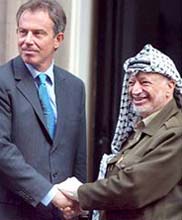
Standing alongside a grave-looking Blair, the
khaki-clad Arafat appeared to precisely calibrate
his remarks in order to meet the needs of both
Washington and London. In the process, he came
perilously close to actually sanctioning their
combined military action against Taleban and
terrorist targets in Afghanistan.
He unequivocally condemned "all forms of
terrorism, including state-sponsored terrorism,"
confirmed the mantra that "fighting terror is not
a war against Arabs or Islam," and rejected
links between "our just cause and methods that
are unjust, like the terrorist acts and killing of
civilians, as occurred recently in the United
States."
He had, he said, told Blair that despite the
plight of the 3.2 million Palestinians who suffer
from "closure and siege, bombardment and
assassinations, the continuation of Israeli
settlement activities, the demolition and
destruction of homes, farms and factories...
I reiterate my full commitment to the ceasefire
[with Israel] that I declared."
And then, after a year-long intifada, he called
on Israel to "immediately join us in resuming
the permanent status negotiations so that we
can reach a just, comprehensive and lasting
solution to all issues on an agreed agenda --
Jerusalem, settlements, borders, refugees,
security, water -- consistent with UN Security
Council resolutions, 242, 338, 425, General
Assembly resolution 194 and all other relevant
resolutions."
Added Arafat: "It is high time to end the
Israeli occupation, to end the conflict between
the two sides and to establish an independent
Palestinian state with east Jerusalem as its
capital -- a Palestinian state next to the State
of Israel so that our people and their people,
and all the people of the Middle East, can live
in peace, security and stability."
Bruised by criticism from Arab leaders that
they favor Israel at the expense of the
Palestinians, Blair and Bush clearly place a
high priority on the need to balance their
military campaign in Afghanistan with
demonstrative new efforts to resolve the
Israel-Palestinian conflict, which they perceive
as the key to placating nervous Arab leaders
and tranquillizing their increasingly restive
"streets."
They have been put on notice that they must
prove they do not simply target renegade Islamic
and Arab states but also take seriously Israel's
"flouting of UN resolutions." And in the quest
to demonstrate their commitment to "even-
handedness" in Middle East affairs, Arafat's
words must have been music to their ears.
The precise form of words he used indicated
that the Palestinian leader was reading from a
script which could have been crafted by officials
at the Foreign Office in London or at the State
Department in Washington. Perhaps both. It is
likely that they provided a clue to the contours
of peace talks that the United States -- and,
perhaps, the European Union too -- will now
be pursuing.
If London was a consolation prize -- Washington
is still not, apparently, ready to receive the
Palestinian leader -- Arafat could console
himself that he was at least being welcomed
by Washington's closest ally.
In the current circumstances, he knows that
when he speaks to Blair he is also speaking to
Bush. And when he hears Blair's voice, he is
probably hearing the voice of George W. Bush
with a middle-class British accent. And if
Arafat used the language that London and
Washington were yearning to hear, the British
leader returned the compliment in spades.
There was an urgent need, said Blair, to seize
the moment, reinvigorate the peace process
and create a viable Palestinian state, with peace
and security for Israel.
"It is now time," he said determinedly, "for all
UN Security Council resolutions to be fully
implemented."
While he told journalists it was up to
Washington to express its own position on the
subject, he added: "I know this is something
they are thinking about very carefully."
Blair said he and Arafat were "in complete
agreement that now is the right time to
reinvigorate this process... This is the time
to act with new resolve."
"We have a chance now to put right the
injustices that have for too long blighted our
world and the Middle East in particular." And,
he said, he and Arafat had "agreed that
negotiations, not violence, is the means."
"It is vital for both sides, especially when faced
with provocation from extremists, to hold fast
and maintain a 100 percent effort to eradicate
the violence that kills not only innocent people
but also the hopes and aspirations of the
majority of ordinary people."
Blair stressed that "the end we desire is a just
peace, in which Palestinians and Israelis live
side by side, each in their own state, secure
and able to prosper and develop.
"That is the only sensible outcome and we
must seize this moment to make progress
toward that end, otherwise more bloodshed
and violence will drive out the overwhelming
desire for peace in the region and the wider
world."
Blair added that "everyone understands that
now is the moment, with renewed purpose
and urgency, to move things forward on the
basis of justice and peace... This is the time
for taking the decisions necessary to achieve
what any sensible, sane person acting with
reason and justice wants to see."
Calling on the Israeli government to
immediately resume final-status negotiations,
Arafat turned to Blair: "You have a very
special role to play."
A few minutes later, Arafat left Downing
Street, flashing the waiting photographers
a million-dollar smile and a Churchillian
"V" for victory sign.
And as of yesterday, Israeli
Prime Minister Ariel Sharon found himself
holding a very hot political potato.
Arafat to the rescue
http://www.jewishworldreview.com --
YASSER ARAFAT has been ridiculed as
a politician who never misses an opportunity to miss
an opportunity. But it is always a mistake to under-
estimate the resilience of the Palestinian leader, who
has survived more than 40 years in the most poisonous
of all political snakepits.

Helen Davis is a veteran London journalist. Comment by clicking here.
