
|

|
|
|
|
Jewish World Review Oct. 29, 1998 /9 Mar-Cheshvan, 5759
Advice from
Residents of a small Eastern Shore town had a front row to history
last week, and some soothing advice for negotiators
WHEN THE WORLD'S BIGGEST STORY comes to your
doorstep, what do you do?
Well, you brag a little about the famous Oak Tree, sell beer
to the guys with ear transmitters, and wonder who's in those midnight
helicopters and motorcades. And, like pundits around the world, you
speculate.
It's not that scenic Wye Mills, a historic Eastern Shore town lined by
expansive cornfields, has never seen the spotlight. A few years ago, Syrian
and Israeli negotiators unsuccessfully tried to hammer out a peace deal at
the Aspen Institute's Wye River Conference Centers here. And there's the
annual fowl hunting season, which should have been rolling along last week.
That event attracts not a horde of reporters, but the relative masses of
eager sportsmen and protesting environmentalists.
Not surprisingly, Jewish life in this flattened landscape of small churches,
a few outlet malls and tiny towns abdicates toward Annapolis, which sits
about a half-hour away, across the Chesapeake Bay Bridge.
But for nine grueling days, ending one week ago, Wye Mills was the most
anticipated dateline in the world. As top American, Israeli and Palestinian
officials holed up at the well-guarded, 1,000-acre facility, the nearby
Chesapeake Business College succumbed to an invasion of the national and
international press. Visiting them was a periodic stream of American,
Israeli and Palestinian officials eagerly seeking to stamp their spin on a
story that had more leaks than the Titanic in its final hour.
A typical occurrence came when Dr. Ahmed Tibi, a top Yasser Arafat aide,
slowly strode toward the outside television cameras Wednesday evening. Eager
journalists poured out of the nearby building.
"It's like rats going after cheese," said a woman security guard who
wouldn't give her name, perhaps because her laughter prevented further
talking.
Dr. Tibi informed the world -- in Arabic, English and Hebrew, that new
Israeli demands were "ridiculous" and preventing success. He declined to
offer details. When the Baltimore Jewish Times asked him about
progress on the Palestinian covenant issue, which repeatedly calls for
Israel's destruction, the Palestinian simply walked away.
This came two hours after Israeli Prime Minister Binyamin Netanyahu's
spokesman, Aviv Bushinsky, gave the world his own pronouncement from the lawn:
either the Palestinians change the covenant, or we're heading home. The
remarks likely were intended more for those inside Wye than the press corps.
In nearby Queenstown, where Palestinians hit the shopping outlets over the
weekend, the U.S. government-imposed news blackout seemed more sacrosanct to
volunteer fire department members.
"You ain't going to get nobody around here to say nothing to you folks,"
said a fireman who wouldn't give his name. "We seen a lot of stuff though
and when it's over maybe I'll give you a call."
His colleague, 19-year-old Thomas Glover, was slightly more effusive. "I
learned that Israel and them have been fighting for a while," he said.
At the Wye Mill General Store, Rhonda Corder had a more welcoming manner.
"Had they kept it more quiet it wouldn't have caused so much commotion," she
said from behind the counter of the well-stocked building. But takeout
orders were picking up thanks to a hungry press corps --- the customary free
food for the media never appeared, and liquid refreshments were moving as
well.
"A guy came in here yesterday and got a 12-pack of beer because he and his
friends were patrolling the river, and I said, 'That's all you need?' He
said, 'I might be back.' And helicopters are going back and forth," she
added. "It puts you on the map and people will come back to the area."
Dwight Riggleman, owner of the store and Mrs. Corder's father, held back
judgment. "All this money is being spent by the taxpayers," he said. "We'll
see if it does any good."
Mrs. Corder's only regret: not being able to give the area's famous visitors
a tour. She certainly would have shown them the Wye Mill, about 200 feet
away; it dates back to 1682. It's not far from the fence-lined Wye Oak; in
1940 it was declared the country's oldest oak tree.
"I'm not a political kind of person," said Mrs. Corder. "But there's a lot
to appreciate here in beauty and quietness." Her advice: "I'd ask [the
delegates] to take a lot of the peace and quiet here back
Wye Diarist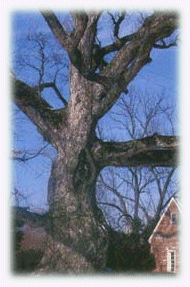
'I wish I could have shown 'em
our historic Wye Oak tree,' (above)
said one local.
the locals
By Neil Rubin

Neil Rubin is Senior Editor of the Baltimore Jewish Times

