 |
|
|
Jewish World Review July 24, 2002/ 15 Menachem-Av, 5762
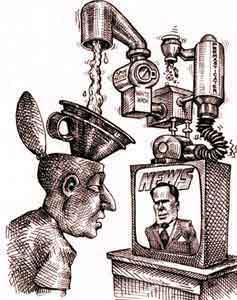
The BBC is quickly becoming one of the world's 'kosher' purveyors of hate
"It should be very interesting," she said, warming to her sales
pitch. "We want to discuss whether Israel is a morally
repugnant society."
"Thanks, but no thanks."
"You sure?" she asked, disbelief mingled with impatience.
"Absolutely positive. Absolutely," I replied, to avoid any
possible confusion.
A moment's silence, then icily: "Okay," and the line went
dead.
The BBC, in my experience, has always been critical of Israel.
At times I have felt somewhat queasy by its coverage; on
occasion, I have thought it downright unfair. But as an Israeli
and a journalist I have defended its right to take a critical view
of Israel, even an extremely critical view. After all, no one
could accuse the Israeli media themselves of being tame. And
besides, I subscribed to the cock-up rather than the conspiracy
theory when it came to BBC coverage of the Middle East.
I argued that the Arab-Israel conflict, anchored in a heady mix
of religious, territorial, political, social, economic and historic
issues, presented an eye-crossing challenge to even the
reasonably well-informed observer, let alone the neophyte
from London intent on establishing a reputation in one of the
world's media hot spots.
September 11 changed all that. Even as the Twin Towers came
crashing down, the BBC was rushing in the first of a stream of
studio analysts to solemnly intone, one after another, that it
was racist to assume that Arabs or even Muslims were
responsible. More likely, they chorused, it was the Mossad
because such an event "played into Israeli hands."
But even if Arabs and Muslims had flown those planes, they
said, was it not obvious that America itself was the real
culprit? After all, it was America that was pursuing a pro-
Israel foreign policy, dictated by the Jewish lobby; it was
America that was ignoring the occupation and turning a blind
eye to the settlements; it was America that was contemptuous
of Arab sensibilities. Could anyone blame the Arabs for
wanting to vent their humiliation, frustration and rage at this
one-sided American foreign policy?
Apparently not. At least not at the BBC, which could not get
enough of it. As I followed the events, I felt increasingly as
though the rest of the world -- or at least that part of it which
was inhabited by the BBC -- had gone stark, staring mad.
Disbelief, it seemed, was suspended at Television Centre as
logic was turned on its heads and victim became perpetrator.
But far more shocking than the repeated ventilation of these
bizarre views was the fact that they went virtually
unchallenged by the BBC's usually robust interviewers.
Forget the apparently inconsequential fact that Israel had only
a few months earlier offered to disgorge 97 per cent of the
West Bank, grant the Palestinians a share in Jerusalem, permit
a limited return of the refugees and recognise an independent
Palestinian state (which no previous ruler in the area had ever
done). Forget all that. In the Newspeak of the BBC, there was
a direct, causal link between the attack on America and the
occupation of the West Bank.
Did the BBC, which reaches into virtually every British living
room, take a conscious policy decision to allow this arrant
nonsense to become an established fact on its air waves? I
doubt it. Rather, I believe, that the profound anti-Israel bias --
and now I am convinced that it does exist -- has, over the years,
become ingrained in the BBC's corporate culture. Combine
that with a massive dose of anti-Americanism and you have a
combustible cocktail.
It is outside the range of my expertise to explain the behaviour
of the BBC in this matter. On the face of it one might have
expected a respected British institution to feel a sense of
affinity with Israel, a Western, democratic state that shares
common values, ideals and aspirations in a region where anti-
democratic, despotic and corrupt regimes are the norm.
Perhaps a clinical psychiatrist could offer a cogent explanation
of the causes and consequences of the BBC's extraordinary
conduct. Or perhaps the answer is far simpler: a reflex reaction
of the grown-up, new-left radicals from the Sixties who now
occupy executive positions in the great offices of state.
Could such a collective mind-set, permeated with post-
colonial guilt, have animated the Director-General, Greg Dyke,
to declare that the BBC was "hideously white"? Could it have
animated the Foreign Office Minister, Peter Hain, in a
previous incarnation, to advocate the violent destruction of
Israel and label Israelis "greedy oppressors"?
If there is a disparity between the time given to Arab and
Israeli commentators on the BBC, I must take some of the
blame. Over the past five years or so, I have been a frequent
commentator on Middle East affairs. Since September 11,
however, I have refused all invitations to appear on BBC radio
or television. The reason is not that I wish to avoid a debate,
but rather that I believe the BBC has crossed a dangerous
threshold.
In my judgement, the volume and intensity of this
unchallenged diatribe has now transcended mere criticism of
Israel. Hatred is in the air. Wittingly or not, I the BBC has
become the principal agent for re-infecting British society with
the virus of anti-Semitism. And that is a game I am not willing
to play, even if, as one BBC researcher recently assured me,
my interview fee far exceeded that of my Arab protagonists
(an outrageously racist point that I, a third-generation refugee
and an exile from apartheid South Africa, found difficult to
applaud).
I am neither an apologist for the Israeli government nor a
defender of its policies. I have been perfectly capable of taking
a critical view of Israel when appearing on the BBC, whether it
was the Israel of Yitzhak Rabin, Shimon Peres, Binyamin
Netanyahu, Ehud Barak or Ariel Sharon. And I am not afraid
of informed criticism from others. On the contrary, I believe
criticism is essential to the health of the democratic process
(although I was always perplexed that Arab guests were treated
with a kind of paternalism that never permitted hard
questions).
I have a problem with the BBC's propensity to select and spin
the news in order to reduce a highly complex conflict to a
monochromatic, single-dimensional comic cut-out, whose
well-worn script features a relentlessly brutal, demonically evil
Ariel Sharon and a plucky, bumbling, misunderstood Yasser
Arafat, the benign Father of Palestine in need of a little TLC
(plus $50 million a month) from the West.
But it was not just the lamentable standards of journalism: I
parted company with the BBC over its systematic, hysterical
advocacy of the most extreme Palestinian positions; an
advocacy that has now transmogrified into a distorting hatred
of a criminal Israel and, by extension, into a burgeoning hatred
of Jews closer to home.
It is astonishing that little more than half a century after the
Holocaust, the BBC, guardian of liberalism and political
correctness, should provide the fertile seedbed for the return of
"respectable" anti-Semitism which finds expression not only
in the smart salons of London but, according to the experts
who monitor such phenomena, across the entire political
spectrum, uniting the far-left with the centre and far-right.
It is astonishing, too, though perhaps no longer so surprising,
that the Oxford University English professor and poet Tom
Paulin should continue to star on BBC Television's weekly
culture panel, despite his clarion call, published in the Cairo-
based al-Ahram last month, to kill Jewish settlers. One can
only guess at the BBC's reaction if his remarks had been
directed at British Asians rather than Israeli Jews.
I still receive a couple of calls a week from producers and
researchers at the BBC - there is obviously a serious
disconnect there somewhere - but they should know by now
that I am no longer a candidate to make up the numbers in
order to allow them to justify the injection of yet more poison
into the national bloodstream.
Nor, as Nicky Campbell's researcher so sweetly asked, am I
prepared to defend the legitimacy of Israel's existence - and,
effectively, the legitimacy of my own existence as an Israeli
and as a Jew. To that I say: "Get stuffed."
Enjoy this writer's work? Why not sign-up for the daily JWR update. It's free. Just click here.
By Douglas Davis


JWR contributor Douglas Davis is the London Correspondent of the Jerusalem
Post. Comment by clicking here.

