
|
|
|
Jewish World Review June 8, 2000 /5 Sivan, 5760
Judaism 101:
http://www.jewishworldreview.com --
UNLIKE OTHER RELIGIOUS FESTIVALS, Shavuos (Pentecost) is
not associated with any specific mitzvah, religious commandment. Say Passover and immediately images of the annual family
Seder and a week of matzah eating are conjured up. On Sukkos (Tabernacles), Jews
literally uproot themselves and move into a hut with a temporary roof of bamboo to commemorate our modest dwellings during the long trek from Egypt to the Holy Land. We also take the "Four Species" of the holy day.
Shavous is the Yom Tov (Holy Day) when we stay up all night learning, decorate our
houses with flowers, and eat a lot of cheesecake and blintzes.
But interestingly, the Torah makes no mention of any of these practices. Why, then,
have they become such an integral part of our Yom Tov celebrations?
And another thing: If Shavuos commemorates the giving of the Torah at Sinai,
wouldn't it be
more appropriate to spend the whole day plumbing the constitution of Judaism, the
world's blueprint? Why do we get caught up in dairy recipes and flowers and
greenery?
The Talmudic sages teach, that since Shavuos is the Yom Tov that
commemorates giving of the Torah, we need to go out of our way to enjoy
ourselves
by eating and drinking. Why? Because the Torah gives us the
most joy in life, and our conduct on Shavuos must demonstrate this.
This is why the Jewish people, for generations, have gone out of their way
to celebrate Shavuos with unique minhagim, customs.
ALL-NIGHT STUDY AND PRAYER
The Kabbalists compiled a tikkun to be recited on the night of
Shavuos,
which consists of portions from Tanach, Mishna, Talmud, the Zohar and a
summary of the 613 mitzvahs. Many people recite this in commemoration of
the Encounter.
In a similar vein, Sephardic Jews have the custom of reciting a poem called
"Azharos," which enumerates the 613 mitzvahs in rhyming lines. This poem,
recited during the Mussaf, or before Mincha, was written by Rabbi Shlomo ben
Gavirol, an 11th-century Rishon in Spain, who composed many piyutim,
liturgy poems.
Ashkenazim, on the other hand, recite "Akdamus," a piyut composed
by Rabbi
Meir ben Reb Yitzchok of 11th-century Worms. Reb Meir was forced to debate
with priests about religion. He confidently proved that the Torah
is the revealed word of Hashem, Supreme Ruler of the earth.
Many people also have the custom to recite Psalms on Shavuos afternoon
in memory of King David, who was born, and died, on Shavuos. In
Jerusalem, to this very day, many flock to King David's burial site on Mount Zion
on
Shavuos. There, they recall his piety and his love of Torah: "The Torah of
Your mouth is better for me than thousands in gold and silver" (Psalms
119:72).
DECORATING WITH GREENERY
On Shavuos, Judaism teaches, the world is judged regarding how plentiful the year's
fruit crops will be. In an effort to remind us to pray for an abundance, the custom of
putting branches
and leaves around the bimas in shuls developed.
Greenery in our houses also reminds us of Moshe Rabbeinu, Moses, who
taught us
the Torah at Sinai. Moshe was born on the 7th of Adar in Egypt, and remained
hidden in his home for three months. On the 6th of Sivan, Shavuos, his
mother felt that it was becoming impossible to keep him hidden any longer, and put him in a
waterproof baby basket "among the reeds" at the River Nile. By decorating our
homes with reeds, or other foliage, we recall the miraculous way that Moshe
Rabbeinu's life was saved. (Chidushei Harim.)
EATING DAIRY FOODS
When the Torah commands, "Bring a mincha offering to
Hashem on Shavuos --- mincha CHadasha LaHashem B'shavuoseichem"
(Numbers
28:26), we have yet another hint to dairy products, since the acronym of
these last three words is "chalav," the Hebrew word for milk.
The mitzvah in the Torah to bring bikkurim, first fruits, to the Holy
Temple on Shavuos
is immediately followed by the command, "Do not cook a kid in its mother's
milk" (Exodus 23:19). To remember the first mitzvah, we make a point of
fulfilling the second one by having milk and meat on the same Holy Day, but
not together.
One of the most famous reasons for eating dairy products on Shavous relates
to the Jews at
the Encounter. After receiving the Torah, the Jews wanted to have a proper
Holy Day meal, but they could not because they had just learned about the Kosher
laws, and realized it would take too long to slaughter animals and kosher the meat.
Instead, they prepared dairy banquets.
The numerical value of chalav, milk, is 40, which reminds us of the
40 days that
Moshe Rabbeinu spent on Mt. Sinai, receiving the Torah. Yet milk, a baby's
sustenance, also reminds us that no matter how much Torah we learn, we will
always be as unenlightened as babies compared to Hashem, with His unlimited
knowledge.
Because milk is white, it symbolizes purity and freedom from sin, a
reminder that when we keep the Torah that we received at Mt. Sinai, we will
be pure and free of sin.
NUMBERS AS SYMBOLS
Women at one time used to bake special long breads with four ends in honor of
Shavuos. This would represent Torah, which is compared to bread (Isaiah
55:2), and the four realms of Torah learning: p'shat, remez, drush and sod.
This bread also commemorated the shtei halechem offering of Shavuos, as
described above.
Some people have the custom of eating meat-filled dumplings (kreplach) on
Shavuos. The
three corners hint to Abraham, Isaac, and Jacob --- Judaism's forefathers;
the Torah, Prophets and Kesuvim --- the books of the Bible ; Kohanim,
Levi'im, and Yisraelim --- the three classes of Jews; Moses, Aaron, and Miriam;
the
three days before Shavuos when the Jewish people were told to prepare
themselves; and Sivan, the third month of the year.
The women in Frankfurt-am-Main, Germany, used to prepare a special food
shaped like a ladder with seven steps. This commemorated the seven heavens
that Hashem opened for Jewry at the Encounter.
In Mainz, the special custom was to bake very sweet breads since Shavuos
was the day when children traditionally began to learn Torah --- this made the
Torah sweet for them.
In earlier times, young children were brought to synagogue on Shavuos
morning
for their first taste of the alef-beis, the Hebrew alphabet. Boards with the
alef-beis letters
and a few verses from the Torah were set up, and honey was put on the
letters. The teacher would read the letters and the verses to the children,
and then allow them to lick the honey. Honey cakes and boiled eggs were
also prepared, all to impress upon the children the sweetness of Torah.
Judaic customs, rooted as they are in Torah and historical
events, can never be taken lightly. Their status is almost equal to
Jewish Law, Halacha, and we can learn much from them about the values
and goals of our
ancestors.
When we busy ourselves with flowers and cheesecake in honor of the Holy
Day, perhaps
we'll have a deeper understanding of why these symbols have become
associated with
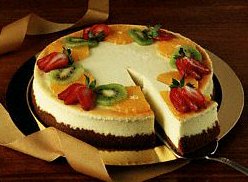
Dairy foods are customarily eaten on Shavous. Why?
Shavuos customs
By C. B. Kaganoff
The most spiritually satisfying, if exhausting, of Shavous
customs, staying up all night immersing oneself in the Torah study,
is first mentioned in the mystical work, Zohar. Since the Encounter at Sinai is a symbolic
marriage between Jewry and the Torah, its authors write, staying up all night in anticipation of
receiving the Torah, is like
decorating a bride on the night before her wedding. In addition, many say
that we are remedying the error of the generation of the Desert, who slept
late on the morning of the Encounter.
 Although Reb Meir died shortly after the debate, his legacy is
Akdamus, a
beautiful poem in praise of Hashem, the Torah and the Jewish people.
Written in Aramaic, over
hundreds of years of persecutions, this poem has annually uplifted Jewry, reminding
us of our glorious status and of the eternal nature of
the Torah and the Jewish people. On Shavuos, the day of the Giving of the Torah,
it is
especially fitting to read this piyut.
Although Reb Meir died shortly after the debate, his legacy is
Akdamus, a
beautiful poem in praise of Hashem, the Torah and the Jewish people.
Written in Aramaic, over
hundreds of years of persecutions, this poem has annually uplifted Jewry, reminding
us of our glorious status and of the eternal nature of
the Torah and the Jewish people. On Shavuos, the day of the Giving of the Torah,
it is
especially fitting to read this piyut.
Another long-standing, custom is to decorate our homes and shuls
(synagogues) with
flowers and greenery. In our youth, we are taught that this act is to remind us of
Mt.
Sinai and the blossoms that covered it in honor of the giving of the Torah.
Yet there are additional reasons.
One of most universal customs of Shavuos, the tradition of eating
dairy delicacies, has many surprising sources. First, we are reminded of the sacrifice
of Shavuos, the shtei halechem, an offering of two loaves of
bread. By serving a dairy meal, and then separate a meat one, we
create a circumstance in which we must have two separate loaves of bread,
one to eat with the dairy meal and one to eat with the meat one. [A
loaf of bread that has been on the table during a dairy meal, according to Jewish
Law, cannot be
then served at a meat meal.] This is similar to the special foods we
eat on Passover that commemorate the Chagiga sacrifice.
Since the Torah is compared to milk and honey (Song of Songs 4:11), it is
appropriate to eat dairy products on the day of the Giving of the Torah. Also, Mt.
Sinai is called "Har Gavnunim" (Psalms 68:17), which is similar to the Hebrew
word "gevina," cheese.
Numerology is a frequent component of Judaic practice, and has a place in
the customs of Shavuos, as well. Sefer Hatodaa records several ancient
customs that are worth remembering, all involving food and numbers.

C. B. Kaganoff is a columnist for
Yated Ne'eman. Comment by clicking here.

